
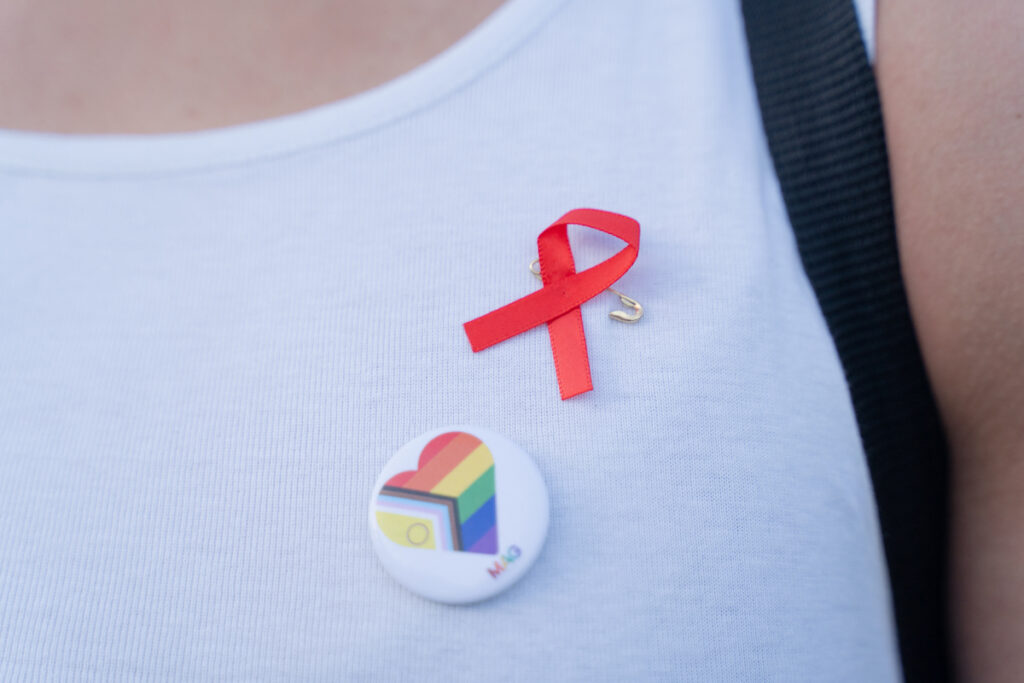
An HIV/AIDS awareness campaign will indeed take place on World AIDS Day, December 1. Fears of its cancellation testify to the distrust of associations toward the government.
Information has recently spread like wildfire through the NGO community: the state is about to renounce the annual awareness campaign organized around December 1, World AIDS Day. In a message published on social media, the Minister of Health, Stéphanie Rist, tried to put an end to the concerns: “It has never been a question of canceling or not carrying out a HIV prevention campaign. This campaign will indeed take place as every year in December”, she wrote on X on September 25.
It is the associations that alerted to the possible disappearance of this awareness campaign. “We learned that the end of the December 1 awareness campaign had been announced during a meeting at Santé publique France, in June”, notes Camille Spire who adds: “We were not told that the government was reducing its scope, but rather that it was abandoning the campaign”. “This communication is nonetheless essential. We need to encourage the general public to get tested. It is also necessary to raise awareness about the discrimination that harms the mental health of people living with HIV”, insists Florence Thune, Director General of Sidaction.
A trust already fragile
It must be said that the current climate keeps AIDS advocacy groups on edge. For several years, they have denounced a withdrawal of state funding. “In three years, government subsidies have almost halved, dropping from 3 to 1.7 million euros, forcing us to close 60 positions out of about 450”, explains Camille Spire, president of Aides. At the start of the year, France halved its participation in the Global Fund aimed at financing the global response to the virus. At the same time, the government took back control of several functions previously entrusted to Santé publique France, notably the implementation of communication campaigns. A reform quickly interpreted by health actors as a political takeover of a mission previously guided by public health imperatives.
The cancellation of the campaign was all the more surprising given that a sexual health roadmap was made public in early September to define the strategy for the next four years. In the document, the government boasts of having implemented “the first national combined prevention campaign, aimed at the general public” and calls for its reiteration.
In the corridors of Avenue de Ségur, people nevertheless wonder how to improve awareness with a constant budget: should the message be concentrated on World Health Day or sprinkled throughout the year? Shouldn’t the television campaign be evolved toward digital channels more used by young people, targeted by prevention messages? So many debates that it is healthy to open with the associations, provided that trust is restored.
