
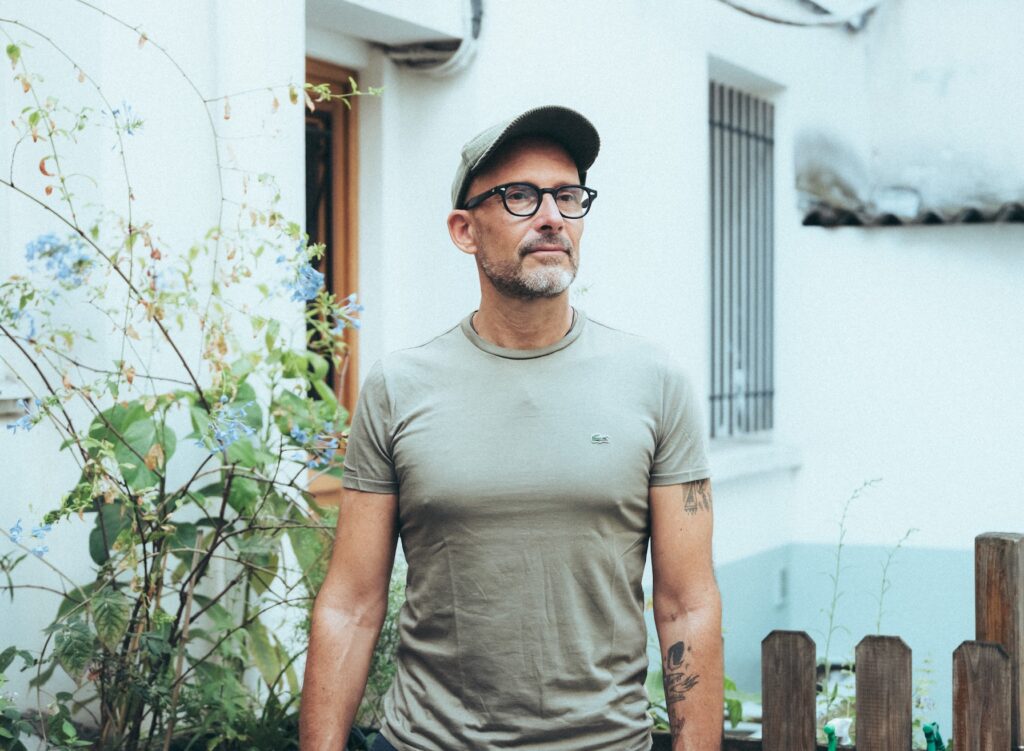
[Article to read in the autumn issue, available at your newsstand or by subscription.] In defiance of part of the queer activist scene, Arnaud Abel champions universalism and secularism without yielding to the far right. This hardcore centrist maintains this balancing act at the head of his association Fiertés citoyennes.
Photography: Antoine Doyen / Mirage Collectif pour têtu·
Arnaud Abel n’a rien d’un révolutionnaire. Ce fonctionnaire parisien de 52 ans revendique même une certaine allergie aux radicalités. Pourtant, depuis qu’il préside Fiertés citoyennes, association LGBT+ fondée sur l’universalisme, la laïcité et les autres valeurs républicaines, le voilà au cœur d’une bataille qui déchire le militantisme queer. Autorisée à défiler à la Pride de Paris en 2023, son association en est aujourd’hui écartée, pour cause de bisbille numérique avec des membres de l’Inter-LGBT.
D’aussi loin qu’il se souvienne, la modération politique a pourtant toujours fait partie du décor. Né à Vannes (Morbihan), aîné de trois enfants de parents travaillant dans une horlogerie, il grandit dans une famille de centre-droit, chrétienne peu pratiquante et guère conservatrice. Un jour, sa mère s’étonne bien de trouver un têtu· dans son sac à dos d’ado, mais son homosexualité ne provoque pas de séisme familial. “Mon père a boudé pendant vingt-quatre heures, puis il est passé à autre chose”, résume-t-il.
Universalism and secularism
His career has the same straight line. After studying law at the Regional Institute of Administration in Nantes, he enters the civil service and passes through the ministries of Health, the Budget, and Justice, with social policies as a through-line. Since April, he works at the Ministry of Agriculture. “I’ve always been interested in public action, where you can see the concrete execution of decisions.” In the corridors of administration, he also notes the gap between promises and the complexity of dossiers, as well as the chronic inability of policymakers to invest in the long term, particularly on ecology. With a consequence that worries him: the rise of populists, a label he attributes to both the National Rally (RN) and La France insoumise (LFI).
He ends up on the other side of the barrier. On the eve of the 2020 municipal elections, a friend drags him into the Gaspard Gantzer venture in Paris. When the former François Hollande adviser withdraws his candidacy, Arnaud Abel joins the team of Cédric Villani. Two years later, it is his own bare head, his black glasses and his three-day stubble that appear on posters for the legislative elections, under the banner of the Union des centristes et des écologistes, a small party that then supported Emmanuel Macron. He knew he would not win and congratulates himself on not finishing last. “It was a wonderful experience. I learned to defend my opinions in constructive political debates.”
It is at this time that Fiertés citoyennes is born. On a Telegram thread, Arnaud Abel and a few friends reflect on how to bring universalism and secularism back to the heart of queer activism. Their founding tribune, published in 2022, aims to respond to a double threat: “Anti-LGBT hatred” and, “in mirror, the radicalization of a minority from this broad community, seduced by identitarian and victimhood ideologies that oppose our republican model”.
The association explicitly claims not to abandon the principles of universalism and secularism, today contested by a portion of the radical left. “Secularism protects the LGBT people”, he calmly objects. “Do you know many countries governed by religious rulers, whether Islamist or evangelical, where the rights of women and LGBT people progress?” For the 120th anniversary of the 1905 law, the association conceived an exhibition in Paris on the topic. “This is about waking the community up to the risk of regression,” continues Arnaud Abel. “If we keep waving battles that aren’t ours, radical activists feed our enemies.” He cites as an example “the omertà” on homophobia in certain working-class neighborhoods: “Refusing to name it leaves the field open to the far right, which instrumentalizes it to win votes from the community.”
Interdicted from Pride
For while he fights against a part of the new queer activism, Arnaud Abel does not miss opportunities to highlight the hypocrisy of the RN on LGBTQI+ issues. When Jean-Philippe Tanguy, deputy for the Somme, defends towns that shelve the rainbow flag, he remarks on X: “The fight against LGBT-phobia is OK only if it serves your xenophobic agenda.” To Bruno Clavet, deputy for Pas-de-Calais, present at the “festival of tolerance and the fight against homophobia” organized by his party in Hénin-Beaumont, he declares: “You fight homophobia in the RN, is that new?”
Since January 2025, on social networks, the anonymous account Le Coin des LGBT, which made a name for itself by summarizing the news before taking a militant turn, nonetheless labels the association as a “groupuscule of the far right”. In a succession of tweets presented as an “investigation”, its author reproaches Arnaud Abel’s positions against the expression “people who menstruate”, his denunciation of “Islamist infiltration”, but also the op-eds published by his association in Marianne, Le Point, L’Express, Charlie Hebdo and even… têtu·.
This ostracism has a concrete effect. After marching in 2023, Fiertés citoyennes is refused access to the Paris Pride parade in 2025. The organizing association accuses its members of online harassment toward its volunteers. In June of that year, again, Inter-LGBT adds to the previous grievance a problem with the registration procedure. “The exclusion from Pride was very difficult to experience for our members”, acknowledges Arnaud Abel, who sees there a maneuver to delegitimize and censor to prevent the debate. Not discouraged, he muses: “To be active in the LGBT milieu, you need thick skin!”
