
From October 23 to 25, in the setting of the Grand Palais, Art Basel brings together more than 200 galleries from around the world. Its new director, Karim Crippa, opens the doors to this edition for us.
Art Basel Paris is a grand gathering of the contemporary art market, certainly, but there is no need to be a wealthy collector to profit from it. Curious visitors can leave their checkbooks at home. At the head of this fifth edition, Karim Crippa defends a fair capable of combining market, discovery, and celebration.
“My journey resembles more a slalom than a straight line”, jokes the 34-year-old director, who knows the house well. He has been here for eight years, first as a writer and then in communications. Born in Switzerland like the event, founded in Basel in 1970, Karim Crippa grew up in Lausanne, far from galleries and the art market. A competitive swimmer until he was 16, he then enrolled at the Academy of Fine Arts in Vienna, in neighboring Austria, before realizing that artistic practice was not for him. He then moved to the other side, working in Vienna, Munich, then Berlin, before joining Art Basel. In the meantime, the fair has expanded worldwide. It arrived in Paris in 2022, succeeding the International Contemporary Art Fair (Fiac).
In the bright nave of the Grand Palais, emblem of the Beaux-Arts of Paris around 1900, Art Basel spans three sectors: “Galleries”, devoted to established galleries; “Emergence”, aimed at young galleries and artists at the start of their career; and “Premise”, specific to the French capital, which favors more singular propositions and historical rediscoveries. Installations are also visible free of charge in different places across the capital, such as Place Vendôme (1st arrondissement) or the Palais d’Iéna (16th arrondissement).
Queer Artists
In the aisles of Art Basel Paris, it is difficult for Karim Crippa to name his favorites. “The beauty of a fair like this is that you don’t have to choose between quality and quantity. There are many excellent things!” When asked about the artists who have shaped his view, several queer figures come to mind: Marie Laurencin, whom he finds “fascinating and mysterious”; Beauford Delaney, “who fled the United States to settle in Paris where he developed a radiant practice”; or Louis Fratino, known for his work on intimacy and homosexual desire, and “whose painting has an undeniable form that deeply captivates”.
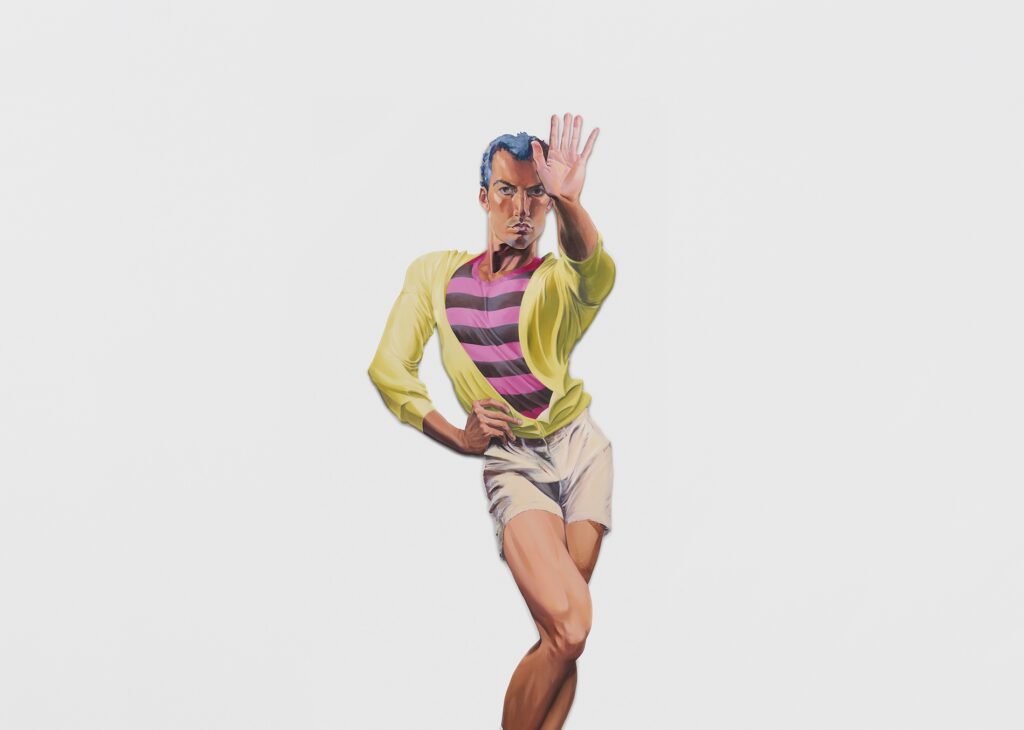
Artists whom he refuses to confine to their queer identity. “It is their capacity to speak to essential topics that touches far beyond their own communities, he argues. Some move extraordinary crowds during their exhibitions.” Among the hundreds of works presented this year, we have selected seven that tell, each in their own way, stories, bodies, and queer sensibilities.
