
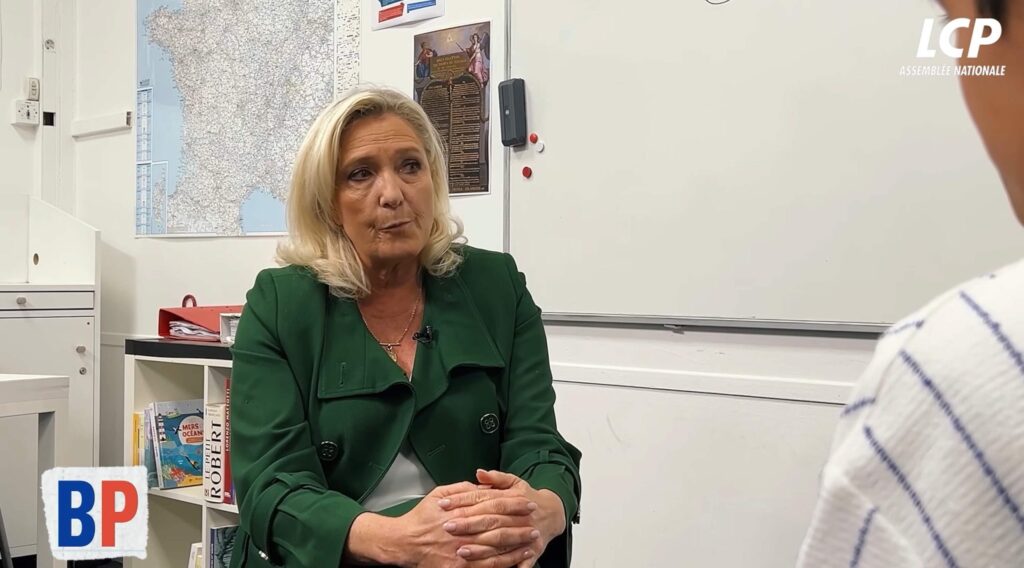
The far-right presidential candidate claims to have changed her mind about the marriage of same-sex couples, justifying her past opposition by a fear of a possible legalization of surrogacy. But fifteen years of statements, press releases, and programs tell a very different story: the relentless battle of Marine Le Pen against same-sex marriage and against homoparentality.
“I’ve changed my mind; it’s not a shameful thing in politics.” On the issue of civil marriage for all, Marine Le Pen also joins the ranks of right-wing repentants. After Valérie Pécresse, Gérald Darmanin or Bruno Le Maire, the leader of the National Rally (RN) says she has moved past her opposition to opening marriage to same-sex couples. A volte-face that the candidate for the 2027 presidential election assumes before Noa, 15, a high school student and aspiring journalist, who questions her in Presidential Credential, a program on the parliamentary channel LCP broadcast on Sunday, November 15.
The young interviewer reminds her of her frontal opposition to the Taubira law in 2013, then her promise to repeal it. “Are you still in agreement with this Marine Le Pen?”, he asks. “No, clearly, I’ve changed”, she answers, before justifying: “The fear that was mine was that civil marriage for all would open, for example, the door to surrogacy. That did not happen.” But this explanation does not stand up to archival review. For Marine Le Pen did not only oppose civil marriage for all for fear of a surrogacy legalization: she long fought the very principle of equality of rights for homosexual couples, notably in terms of marriage, adoption and parentage. And the statements of the time, as well as the successive programs of the Front National, which became RN, are still there to testify to it.
Gay marriage and “polygamy“
From 2011, a year before her first presidential campaign, Marine Le Pen sets the tone. Invited on France Inter, she reacts to François Hollande’s proposal, then future PS candidate for the presidency, to open marriage to same-sex couples. To justify her opposition, she cites the risk of upheaval to society: “I don’t think it’s positive to change this rule, because if we start from this principle, we could go very far in modifying our civilization”, she argues. Before pushing the comparison: “And why not the authorization of polygamy then?” From that time, it is thus not surrogacy that she invokes to oppose civil marriage for all, but the fear of challenging the rules of matrimony and, more broadly, the social order.
To reiterate her opposition, the party published a press release on September 12, 2012. Regarding “the same-sex marriage”, the Front National pointed to “an ultra-minority claim”. As for adoption by homosexual couples, the far-right party denounced a “grave measure for the child’s interest”, which would aim to “deny a biological reality: a child is the fruit of a father and a mother who each have a fundamental role to play in its construction and its balance”. A few weeks later, on November 29, its vice-president Louis Aliot hammered the point by attacking the opening of medically assisted procreation (MAP) to single women and to lesbians, another promise of the socialists, whom he reproaches for wanting to “go even further in destroying our values and our traditions”. Stop, no more.
Marine Le Pen, LMPT
This rhetoric aligns with that of La Manif pour Tous (LMPT), the collective mobilizing hundreds of thousands of people against opening marriage to same-sex couples. Nine days before its first major demonstration on January 13, 2013, Marine Le Pen published a statement in which she reaffirmed her opposition to marriage and adoption for homosexual couples, but also to MAP. She denounces again “ultra-minority claims, not even supported by the majority of homosexuals” and invokes “the sacred right of the child to have a father and a mother”. The president of the Front National lends her support to the party’s elected officials who will participate in the demonstration.
The Taubira law’s passage on May 17 does not change her determination. Two days later, invited to the program C Politique on France 5, Marine Le Pen confirms her will to abolish the text if she comes to power: “Yes, I will abolish it. Yes, I have taken the commitment.” She notes, however, that she does not intend to revisit marriages already celebrated: “People who have married will remain married because it would be illegal to remarry them. Conversely, others will not have the possibility to do so.” Instead, she proposes an improved PACS, and confirms her opposition to adoption by homosexual couples, in the name of the “right of the child” rather than the “right to a child”. Surrogacy remains off the topic.
Opposed to marriage and homoparentality
Four years later, Marine Le Pen has still not given up. In her 2017 presidential program, laid out in 144 commitments, the candidate promises to “maintain the prohibition of MAP and reserve MAP as the medical response to infertility problems”. But, in the same proposal, item 87, she also commits to “create an improved civil union (enhanced PACS) that will replace the provisions of the Taubira law, without retroactive effect”. The contradiction with her explanations today is obvious: while she intends to maintain the ban on MAP in France, Marine Le Pen still proposes to abolish civil marriage for all. Her opposition to this right cannot therefore be reduced to the fear of a legalization of surrogacy.
Concretely, this program would have created two categories of homosexual couples: those who had already married, whose union would remain recognized, and those who would no longer have had the right, forced to content themselves with an “improved PACS”. A rollback of an achievement from which more than 32,000 same-sex couples had benefited since 2013. And on the question of homoparentality, Marine Le Pen remains inflexible: “I wish that filiation remains the result of a father and a mother”, she affirms again in June 2019.
Changing coats and versions
On MAP, the same consistency. On June 28, 2017, the day after the National Consultative Ethics Committee’s (CCNE) favorable opinion on opening it to female couples and to single women, Marine Le Pen says she is opposed to “creating children without a father”, a prospect she judges “eminently negative for the child in question”. On June 29, 2021, during the final vote on the bioethics law, Marine Le Pen and the other RN deputies who took part in the vote vote against the text, which opens MAP to all women.
After suffering two political defeats on marriage and MAP, Marine Le Pen eventually abandons, in her 2022 presidential program, the plan to repeal Taubira’s law. On April 15, in Pertuis (Vaucluse), a voter married to a woman asks her about the fate of her union in case of victory. “I will not take away any rights from anyone”, she promises, before confirming on Twitter: “Same-sex marriage is and will remain an achievement if I am elected President of the Republic.” Out goes the “improved PACS” and the promise of repeal. It will take her another four years to craft the tale about the reason for her conversion. Changing one’s mind is not a shame in politics, indeed. Rewriting history, that is less glorious.
