
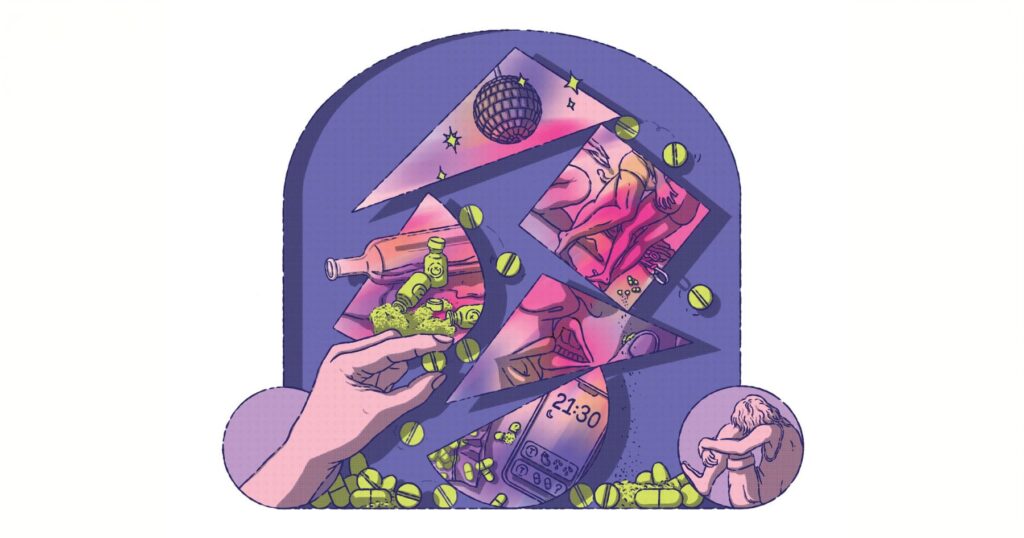
Stopping chemsex can mean giving up an entire world: parties, lovers, friends. Those who have gone through it tell of the lost ties, those who resist, and those who create new ones.
With Antoine, friends, lovers and dealers had long been one and the same. Once the decision was made to distance himself from chemsex after failing his agrégation, blocking certain numbers meant giving up far more than just suppliers. “I feared I would no longer have access to a world where I would always be welcome. To be abandoned, in fact.” As if, with the last bag flushed down the toilet, an entire social world could disappear, swallowed by the flush.
Antoine, however, ended up blocking his “chemsex mates” and accepting that some important relationships would dissolve. He notably cut ties with two dear friends. “They still matter to me, I’d like to hear from them, but the drugs were one of the cement of our friendship”, he notes at 31. “When you remove it, the bonds are no longer the same.”
Joe, for his part, took a one-way trip to Spain. This other thirty-something began by crossing Saturday nights off the calendar, up to the point where the sequence before-party-after used to set the rhythm. “I used the same drugs on a dance floor and in bed, so I knew very well how it would end”, he admits. “Chemsex was the weekend’s dessert, lasting twenty-four or forty-eight hours. A ‘chem’ night is like Grindr: you can’t ‘just pass’ when you’re hooked.” As the parties, a good portion of his sociability vanished. Joe does not immediately seek to replace it. His long descent he endures hunkered down, “without joy in life or desire to connect”. The trap is obvious. “You’re alone, you get depressed, and when you’re depressed, you want to use”, he enumerates. He first needs to relearn to be alone without feeling abandoned. He thus gives himself a kick in the pants to take a bath, watch a series, go for a walk… At first almost mechanically, then again out of desire. He waters the desire to make it grow again.
Some of his circle, including his flatmate, only consumed in festive settings. “The rest of the time, we could meet without risk.” Joe realizes then that his old social life hadn’t disappeared: he had neglected it. “People were waiting for me”, he realizes, not yet daring to call them “friends.” It remains to rediscover the taste for relationships that, for too long, had seemed bland to him: “I saw them less because I wanted them less than the rest.”
Antoine, for his part, filled the void with studies, the ones he had failed the first time. He also began seeing a few friends again. Few, but better, with a simple rule: “My sociability must be a place where I am not in danger.” After the university library, he went for a drink with his study partner, simply because he recalls having loved that before. “And it was great!” he smiles. Friends are like riding a bike. Some come back; others drift away; most had already left. Antoine counts on the fingers of one hand those who stayed. But they are now the most precious: “A friend to call when craving and my brother who had control of my finances”, he details, organized.
Creating a Social Life Elsewhere
Renouer with the party can also be part of recovery. It is in this spirit that Alexandre Nadra, a professional dancer, had imagined BPM Workshops in Paris. The aim was to “recreate the festival experience, drug-free, giving everyone the possibility to choose afterwards”. And above all to offer a midweek gathering, when loneliness can feel particularly acute. “I wanted to show that music can bring you into a trance, just like drugs, if you let yourself be carried along”, he explains.
Others sought this community elsewhere. Emiel, 32, an NGO employee, joined Not Today, a London-originated collective that gathers during the week, in a sober space, people wishing to interrogate their consumption. Its raison d’être could rest on a question: “Everyone calls you on Saturday, but who calls you on Wednesday night?” Emiel took time to find his answer. “When I arrived in Paris, I thought consumption was necessary to fit into these spaces”, he recalls. “Today I’ve been able to distance myself from it because I’ve managed to create a social life elsewhere.”
Victor, 38, has not always been this ultra-social type who jokes all the time. “I am very shy”, warns this history-geography teacher. For a long time, the high from drugs served as his passport. High, he manages to flirt, to find a place. The drug did not just help him to enjoy more: it opened the door to a world. “It was convivial”, he sums up. With now plenty of time available, he engages in his martial arts club. Previously, he looked with perplexity at those guys who dedicated their weekends to a club. Today he is proud to be one of them. More recently, he has taken up swimming.
His recovery also passes through Narcotics Anonymous, where he meets people “who have the same journey” and with whom he has “woven sincere relationships”. Some Saturdays, this “little group of allies” organizes its own outings: movie, pizza and popcorn, then, for those who feel strong enough, head to the club. The others go home to sleep. Victor is among the first.
Nevertheless, he had to accept that some relationships belonged to his life before. For almost three years, he considered himself on pause. “I told myself I would return among them”, he says about his after friends. A recent rave with his crush reminded him of the fragility of this balance: “Having sex with him while he was high made me fragile; I almost gave in.” He then pulled back from that boy and his world.
Sobriety does not necessarily mean giving up the party. Victor learned to manage risky situations. At an after-work gathering, if he recognizes the regular path to the bathroom, he simply leaves earlier. His nightlife may have shrunk, but his social life seems broader: “Today, my world is bigger than back when it was all about finding the right after-party.”
