
[Article to be found in the autumn issue, at your newsstand or by subscription.] Never quite political enough, nor sufficiently representative or exemplary, Drag Race France concentrates ever-growing expectations. Over time, the show is accused of everything and its opposite.
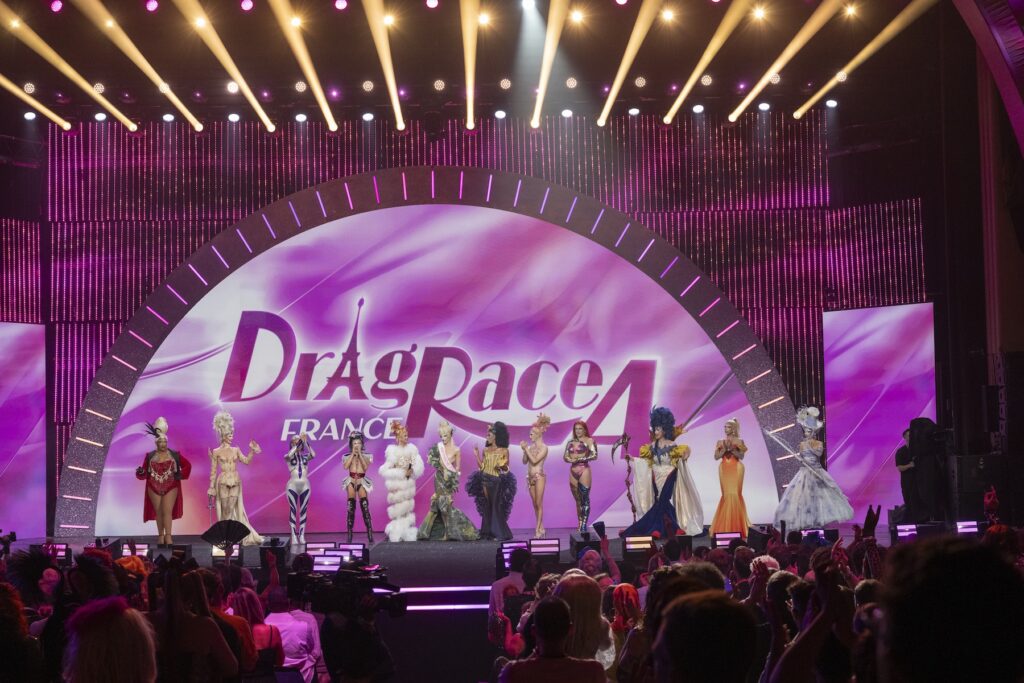
Fans of Drag Race France have been particularly generous with criticisms this year. Throughout this fourth season, between Daphné Bürki’s remarks that land poorly, Nicky Doll’s misunderstood rankings, and eliminations that left a sour taste, the gap seems to have widened between a portion of the audience and the show broadcast by France Télévisions.
Beyond the choices inherent to any reality competition, one grievance returns: Drag Race France would have lost some of its political impact. Even the intimate confession sequences, ritual of the franchise, are accused of becoming mechanical or skimming over their subjects. This season, however, some queens spoke of chemsex in the workshop, bringing into a broad-audience show a topic still largely confined to LGBT+ media or treated as a matter of current events. Young people from Refuge also came to recount the family rejection they had endured.
“When I look at most versions of the franchise, I don’t find ours any less political than the others,” says Fabien Randanne, culture journalist at 20 Minutes. These testimonies are valuable because they break down prejudices with the general public.” It remains to be seen what exactly is expected, in France, from Drag Race. That the show is funny and spectacular goes without saying. But also, according to the criticisms leveled at it, that it values queer culture and LGBT+ diversity, raises awareness of discrimination, engages in health-sexuality prevention, tells of our miseries and does not forget, along the way, any letter of the acronym or any blind spot. The rarity of LGBT+ representations partly explains this demand: each of them is called upon to bear much more than itself.
The paradox is that Drag Race France is also attacked for the opposite reason. If the reactionary camp remained relatively discreet during Season 4’s broadcast, Deputy Charles Alloncle (Union des Droites, ally of the National Rally) made his presence on public television the emblem of an audiovisual sector he deems too “woke.” Too political for some, never enough for others: it is difficult, under these conditions, to simply have queens sashaying in wigs.
The Fans’ Court
“Some take pleasure in tearing the show down, while it remains an exception on French television,” notes the Nantes-based queen Jodye Coaster. If these same people directed the same venom at countering the actions of the far-right, which will have a real impact on our future, we would be better off.” The brief also extends to the contestants. Even before the competition began, Azémylia and Holly White were sharply targeted on X (Twitter) and Instagram, both accused of cultural appropriation for past looks inspired by Asian or Afro-descendant cultures. In the face of the scale of the attacks, France Télévisions eventually called for calm.
Critiquing a performance, a look, or a queen’s journey is part of the game. The editing and storytelling of the show are precisely designed to provoke discussions, preferences, and disagreements. “When you agree to participate in the show, you sign up to be criticized,” admits Cyrcé Loomis, a Parisian drag artist who had considered joining the show. It’s normal to express your opinion about a queen’s work, but there are ways to do it.
The problem begins when evaluating a performance becomes a judgment of the person, and the fault becomes a reason for disqualification. “This year, the audience proved very hard,” continues Cyrcé Loomis. As if they had taken upon themselves a duty of justice and that everyone had to be flawless.” Fabien Randanne makes the same observation: “This militant purity has become a constant. There is no right to error or a second chance.”
Behind the Instagram accounts, there are nevertheless artists who have spent months in preparation, invested significant sums in their outfits and, sometimes, their professional future. “Those who criticize so violently forget that they are taking aim at people who are launching a career, a life change, hopes and a lot of money,” reminds Jodye Coaster. It’s peculiar, for a community that is often the target of harassment, to reproduce these patterns within its own ranks.”
Gradually, the risk is that drag queens decide the game is no longer worth it. “I find that Drag Race isn’t as dreamy as it used to be, confides Cyrcé Loomis. I don’t think I want to expose myself to hundreds and hundreds of hateful comments just to get a bit of light. The more virulent the fans are, the less their local drag queens will want to participate in the show.”
One can always point to a missed season, an insufficient political sequence, a ridiculous judgment, or a scandalous elimination. Thank goodness! It is even a sign that Drag Race France matters to its audience. The franchise does not claim to be exempt from criticism simply because it provides unprecedented queer visibility on French television. But no show can by itself repair the shortcomings of others, just as each queen cannot be expected to be an immaculate ambassador for the community. We already ask of a queen to know how to dance, make people laugh, perform, sew fabulous outfits, nail a lip-sync, master makeup like no one else, and hold a stage… If she must, in addition, be politically irreproachable and master the right theoretical corpus before taking the stage, soon there will be another challenge added to the program.
