
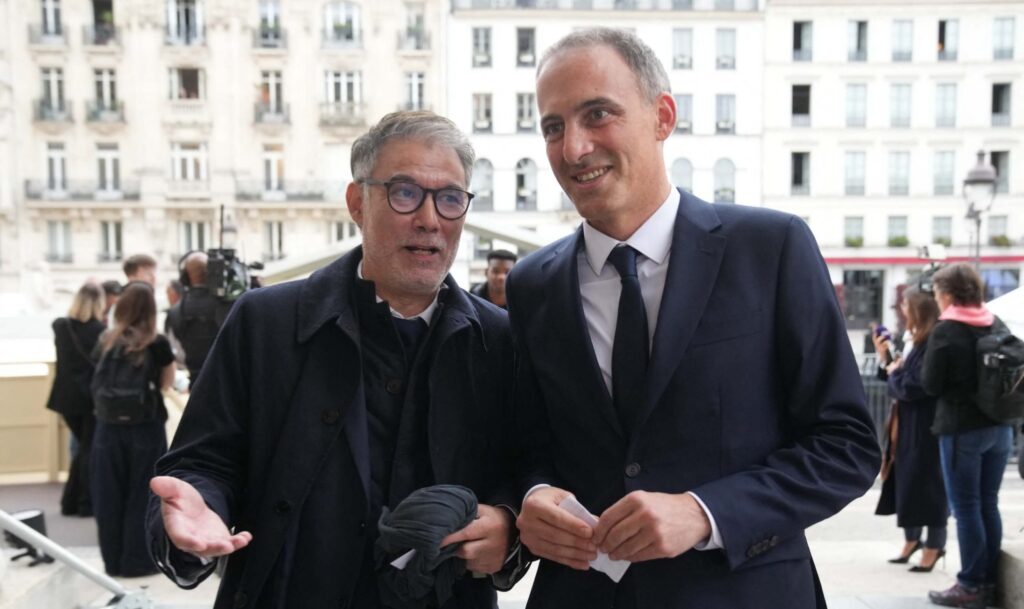
Five candidates, two rounds and an open vote to the public: the Socialist Party and Place Publique, the movement of Raphaël Glucksmann, organize in October the primary “Choose 2027” to designate their candidate for the presidential election. How-to.
How not to repeat the catastrophe of April 21, 2002? Twenty-five years and four presidential elections after Lionel Jospin’s elimination in the first round by Jean-Marie Le Pen, the left keeps in memory its cardinal sin: eight candidates from its ranks were on the first-round ballot. Since then, dispersion has stood as a catastrophe scenario.
After the trauma of 2002, the socialist left has not approached a single presidential election without organizing in advance a selection process, with changing modalities. In 2006, the Socialist Party (PS) organized an internal primary that proclaimed Ségolène Royal; in 2011, an open primary to the public designated François Hollande; in 2017, the primary of the Belle Alliance populaire crowned Benoît Hamon; in 2021, a new internal PS primary designated Anne Hidalgo.
And for 2027, then? The leftist electorate has not forgotten, showing 82% in favor of a primary, according to an Ipsos poll published in the spring. On the side of the leaderships, it is less clear. As early as July 2025, socialists, ecologists, and former members of La France insoumise (LFI) pledged, during the “oath of Bagneux,” to present a shared program and a common candidacy in 2027. The family photo then brings together Olivier Faure (PS), Marine Tondelier (The Ecologists), François Ruffin (Debout!), Clémentine Autain (L’Après) and Benjamin Lucas (Génération·s). Appointed guarantor of the process, Lucie Castets declared in têtu: “I hope the union will be as broad as possible for the presidential election. It is the condition for the left to govern.”
But why make things simple when you can make them complicated? A year later, the cards were shuffled again. The primary arising from the oath of Bagneux, initially planned for October 11, did not endure, falling victim to divisions within the PS and to Raphaël Glucksmann’s refusal to participate with his movement, Place Publique (PP). The Communist Party (PCF) and LFI had likewise declined. This summer, the PS announced the organization of “Choose 2027,” its primary “socialist and democratic”, whose principle was approved by its militants on July 9. The modalities were then negotiated with Place Publique and definitively settled at the end of August. Here is how they work.
Who can stand in “Choose 2027”?
The primary separates the candidatures coming from three parties: the PS, Place Publique and the Gauche républicaine et sociale (GRS). Not all are subject to the same rules. The socialists must obtain the endorsement of 15 members of the National Council, 10 parliamentarians and 50 mayors or presidents of intermunicipalities, or 50 departmental or regional councilors, the last two categories having to be distributed across several departments and regions. Place Publique and the GRS set their own candidacy conditions on their side and have already designated their representative.
Who are the five candidates?
Raphaël Glucksmann is a frontrunner in the polls. The MEP from Place Publique has notably won over Boris Vallaud, president of the PS group in the National Assembly, as well as Yannick Jadot, the ecological candidate in the 2022 presidential election.
Olivier Faure, the PS’s first secretary, defends a different line. A builder of the Nouveau Front populaire (NFP) during the 2024 legislative elections, he had enabled the left’s unity with La France insoumise after the dissolution of the National Assembly.
Another figure of the race is: Ségolène Royal. Qualified for the second round of the 2007 presidential election and later minister of Ecology under François Hollande, she now recycles her “order just”, to which she adds “La France tranquille”, echoing François Mitterrand’s “la force tranquille”.
Two other contenders complete the lineup: the socialist Jérôme Guedj claims a line “universalist and pro-European”, while Emmanuel Maurel, candidate of the Gauche républicaine et sociale (GRS), aims to “defend the workers”.
A sixth candidate was in the race: Philippe Brun. But Le Monde reports that the PS’s national bureau, meeting on Wednesday, September 16 to validate candidatures after the filing deadline, suspended the Eure deputy provisionally following “a referral by the leadership for serious facts” linked to a former assistant. “I do not know these facts,” reacted the concerned man to RTL. I note that on the basis of a report sent yesterday at 11:50 p.m., a parliamentarian who had collected all his endorsements is barred from being a candidate. He will therefore not participate in the primary.
What does participating entail?
All the candidates must sign a charter. It commits them, once designated, to “propose a gathering of all parties of the democratic, ecological and republican left” in order to build “a common program, a legislative agreement and a government contract”. In other words, how far does it go? Raphaël Glucksmann, firmly opposed to Jean-Luc Mélenchon, wanted to explicitly include the exclusion of any agreement with La France insoumise (LFI), particularly for the upcoming legislative elections. The PS leadership obtained that this exclusion would not appear in the charter.
Who can vote?
Members up to date with their dues of the PS, Place Publique and the GRS can participate in the ballot. Others must register on the “Choose 2027” platform and pay 15 euros, or 10 euros at the social rate for the unemployed, students, and people with low incomes. To vote in the first round, registration must be completed before October 5 at 23:59.
The price has raised eyebrows even among the candidates: Olivier Faure notably denounced the risk of a “census vote”. Fifteen euros is indeed far more than the symbolic euro requested per round during the 2011 citizen primary.
When will the primary take place?
The vote, entirely digital, takes place in two rounds: October 9 and 10 for the first round and, if no candidate wins a majority, October 16 and 17 for the second.
Three debates are planned before the first round: on September 23 on LCI, on October 1 on France 2 and France Inter, and then early October on BFMTV, at a date to be determined.
But everyone has their own calendar: François Hollande has announced that he would decide in December whether to run in the presidential election… Which could shuffle the deck again at the end of the year.
