
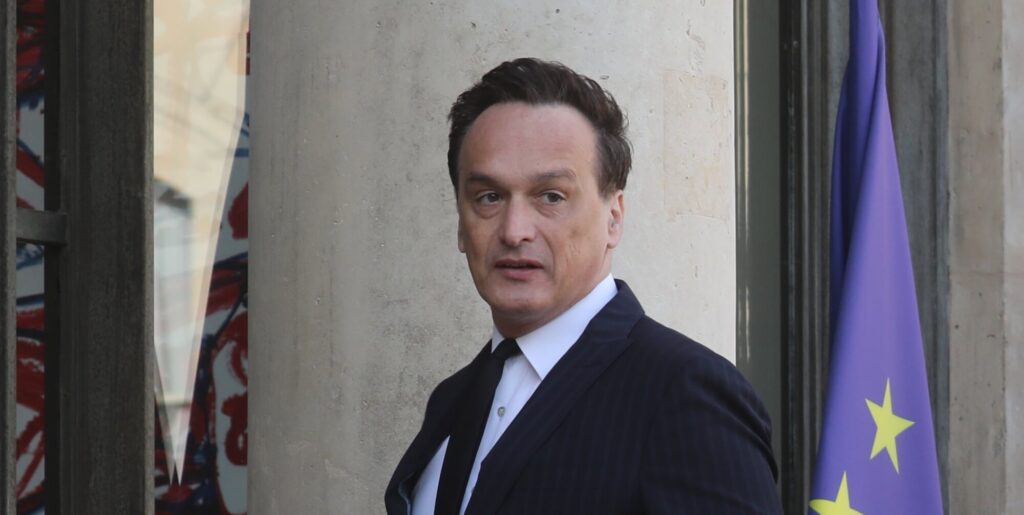
First holder of the post of ambassador for LGBT+ rights, created by Emmanuel Macron in 2022, Jean-Marc Berthon publishes a book, Fragile Liberties (Grasset), which sketches a panorama of the situation worldwide and warns about the risk posed by the reactionary push, including within democracies.
- In the global confrontation between reactionary and progressive forces that we are witnessing, how much impact did Donald Trump’s reelection to the presidency of the United States a year ago have?
Jean-Marc Berthon : The return of Donald Trump to the White House has strengthened the polarization of the world. Obviously, when the world’s greatest power shifts to the reactionary camp, many countries feel encouraged in that direction. But this also triggers, in parallel, a surge among liberal countries that feel obliged, from Canada to Romania via Australia, to defend more ardently democratic values. Through their trade policy, their support for Russia, their handling of immigration, the United States have moved, in the eyes of many other countries, from the status of model to that of counter-model. So it is not the final victory of conservatism but an amplification of the struggle, a reaffirmation of universal values.
- In this new game, does Europe manage to position itself as a model?
Without a doubt. Admittedly, some European Union (EU) countries pursue anti-LGBT policies, but those are few: Hungary and Slovakia, notably. The overwhelming majority of EU member states are in favor of full inclusion of LGBT+ people in society, in the name of Enlightenment-era universalism.
- To you, the state of LGBT+ rights is an excellent indicator of the health of a democracy…
The relationship is direct: where democracy is absent or in crisis, LGBT+ rights are systematically attacked. We have lived fifty years of remarkable progress, with the decriminalization of homosexuality in two-thirds of the world, the recognition of transgender identity and of same-sex parenting in many countries… and we thought these advances were secured. In reality, for about ten years now, we have observed a tightening and rollback of rights in a number of countries across all continents. This is linked both to the historical swing of history, to the crisis of democracy, as well as to the rise of an anti-Western sentiment.
- You define three essential ingredients for the advancement of LGBTQI+ issues: democracy, economic prosperity, but also the secularization of society. The latter, secularism, has today a bad press even in some queer circles…
If one looks at ILGA’s map of LGBTQI+ rights, the countries that defend them are indeed the most secularized. The monotheistic religions – Christianity, Judaism and Islam – are all three stern with homosexuality and transgender identity, which they consider a sin that goes against a natural order dictated by God. For LGBT+ people, it is therefore crucial that civil law not be the application of religious law.
- Religions hostile to LGBT rights, is that, in your view, an inevitability?
The religious leaders can only progress gradually. Pope Francis had taken steps, calling for the decriminalization of homosexuality or for blessing gay couples… The current pope seems to be moving in the same direction, when he allows an LGBT pilgrimage to the Vatican and when he receives a delegation of transgender people. I am convinced that if we evolve in the coming decades, it will notably be thanks to a less hostile attitude from religions.
- As for nationalists, traditionally anti-LGBT as one can always see on the African continent, now they claim to be pro-LGBT in France, with the National Rally highlighting its openly LGBT elected officials…
Homonationalism proclaims to defend the homosexual cause—but not that of transgender people—in the name of defending a lifestyle that would be threatened from the outside. But for the Republic’s government, the only legitimate reference is that of universal rights: there exist fundamental human rights—particularly the right to privacy, not to suffer discrimination, to freedom of expression—that must benefit everyone, including LGBT+ people. It is with this approach that we remain faithful to our history, the 1791 heritage that led to the abolition of sodomy as a crime.
- Populisms systematically attack the judiciary, or you remind that many rights were won thanks to it, notably in Latin America…
The ideal of populisms is the imposition of the majority view on the minority. It is false to believe that the culmination of democracy is to twist the arm of the minority. It is a balance between majority rule and the defense of minority rights by the checks and balances. This is why populisms systematically attack justice and the media, which represent the first checks on power.
- Is the judiciary sufficiently solid, for example in Europe where its decisions are regularly questioned?
LGBT+ people do not fully realize what they owe to European justice. In the 2010s, the European Court of Human Rights (ECtHR) produced case law that helped advance LGBT+ rights toward inclusion. Today, the Court of Justice of the European Union (CJEU) is a bulwark against governments pursuing an LGBT-phobic policy. It recently ruled that a same-sex marriage contracted within the European Union must be recognized by other member states, and it is expected to issue a decision soon regarding Hungary’s anti-LGBT+ legislation.
