
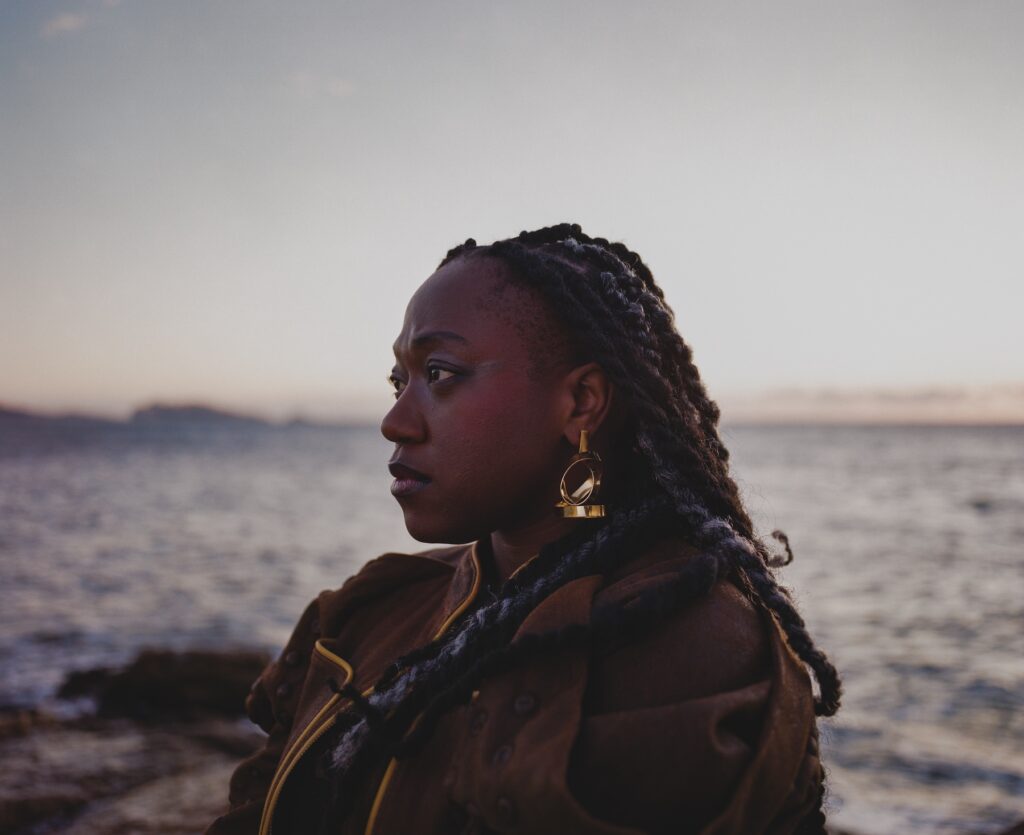
[Portrait to be found in the autumn issue, at your newsstand or by subscription.] In At My Softest, I Am Most Dangerous, her fifth album, Mélissa Laveaux transforms trials into a music inhabited by spirits, celebration and desire. She is currently on tour.
“With all that is happening, why not party?” The question alone sums up the paradox that nourishes Mélissa Laveaux’s new album. Released in March, At My Softest, I Am Most Dangerous is threaded with death, mourning and trauma, without yielding to despair. The author, composer and performer of 41, a Franco-Canadian of Haitian origin, prefers to gaze the darkness in the face to oppose it with a music that is decidedly alive. “I like making strange songs, raw things, so that we cry, laugh and dance“, explains this aficionado of oxymorons, even in her way of resisting.
Throughout the record, the most autobiographical of her five albums, Mélissa Laveaux explores the different facets of her identity as a Black woman, queer and living with primary progressive multiple sclerosis, a chronic evolving illness that affects her muscles and mobility. Her traumatic experiences mingle with a flourishing spiritual imagination. Cassandre, her sister, lends her voice to the interludes that punctuate the narrative. Her music, nourished by Antillean sounds, which she describes as “psychedelic Afro-rock,” makes a point of highlighting the electric guitar, which she has played since her father gave her a second-hand one for her first communion, at age 10.
During our meeting, Mélissa Laveaux is interrupted by Instagram notifications lighting up her phone. She opens a homophobic comment left beneath a video of her performance at the Fier Gala, which took place in June in Paris, and reads it aloud. Then she raises her eyes, almost amused: “You see, those who take the time to write horrible things to us hide, in fact, and lock themselves in a frustration that they themselves feed daily.”
Beyond the Chaos, Life
Online harassment seems trivial in comparison to what she has already endured. “I have nearly died many times, so I make the most of being still here to touch people with my music”, sums up the artist. Moreover, she philosophizes, “when you are queer, I think we have already lived the end of the world: losing your family because of a coming out is already the end of the world, AIDS is another end of the world… Building above the chaos is a queer way of life.”
This way of inhabiting chaos did not come about overnight. Born in Montreal, Mélissa Laveaux grows up in a divorced family and under a devout Catholic upbringing. At 25, she moves to France with a work permit to teach French and English. During a visit to her mother, who remained in Quebec, she tells her about moving in with her friend Léonie. Her mother gasps: “But Léonie is a lesbian! And you, are you a lesbian?” The reply will not please her. The next day, a priest awaits Mélissa in the family dining room.
“Black people are not homosexuals”, he tells her. The ensuing confrontation between mother and daughter is one blow too many. The young woman leaves with those maternal words in mind: “Filthy demon”. On her album, Mélissa Laveaux sings in “Yemaya” (a Yoruba deity associated with the sea and motherhood) a flag that bleeds (“The flag, it bleeds”), then addresses someone who has brought her to her knees and who, trying to dictate her way of seeing, has finally stripped her: “You claimed my eyes, you set my sight all right”.
The episode pushes her to seek God in other traditions, such as Haitian voodoo. “I tell myself often that if I am still alive, it is thanks to an energy greater than me…” Behind her ghosts and mystical references, Mélissa Laveaux celebrates above all a strange luck, the one that reaches us in our guts during an eclipse: standing in the sun.
