
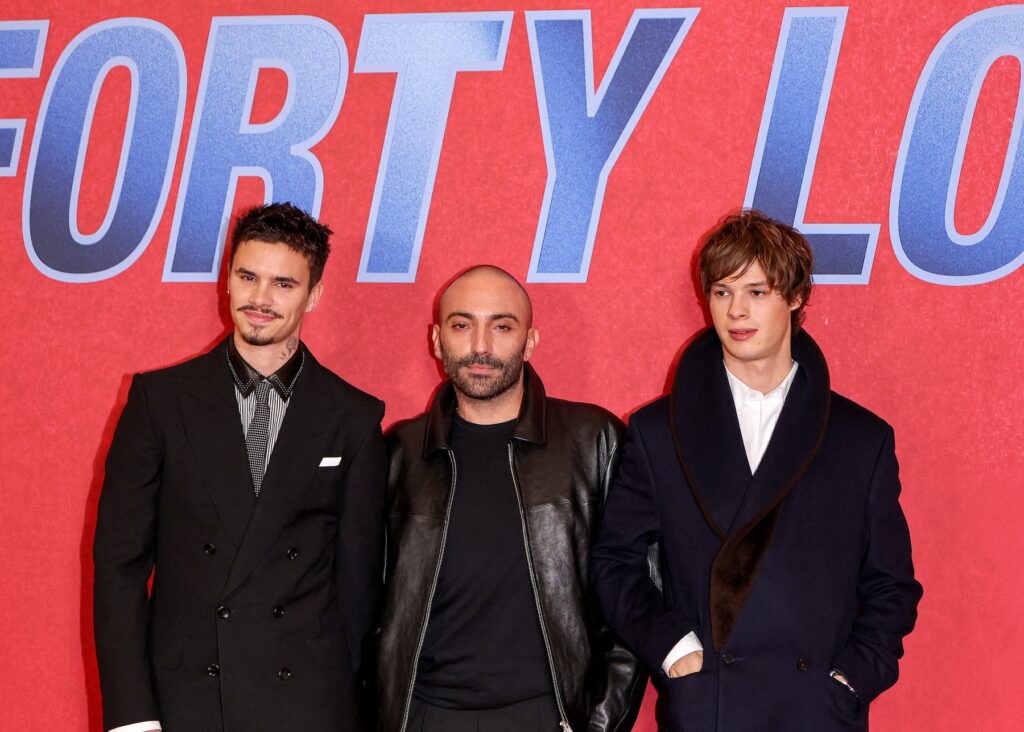
With Forty Love, his first feature film hitting the cinema on November 25, the photographer Pierre-Ange Carlotti tells a love story between two tennis players. And he asserts that filming romance leaves him far more exposed than his most provocative photographs.
In Forty Love, in theaters this Wednesday, November 25, Sacha (Paul Kircher), a young tennis hopeful coached by his father (Guillaume Canet), sees his certainties shattered when he meets a new rival, played by Romeo Beckham, who makes his acting debut here. Behind the camera, Pierre-Ange Carlotti, a 37-year-old fashion photographer known for his raw and sensual images, who has worked for Saint Laurent and Balenciaga. For his first film, the provocateur, as he is described, claims a very different ambition: to tell a gay fairy tale, where desire unfolds even before the first kiss.
Your photographs earned you a reputation as a provocateur. Yet with Forty Love, you sign a film that is deeply romantic. Is this another way of revealing yourself?
I think offering provocative things allows you to protect yourself, to keep others at a distance. For me, Forty Love is the opposite. It’s a romantic film and I feel much more laid bare by showing so much romance.
What love story did you want to tell?
I wanted to tell a love story between two boys, in the style of a fairy tale. My guiding principle was to move toward the light. I also wanted to make a film about desire and everything that happens before a kiss because I feel that gay desire is too often represented in an ultra-sexual way. It doesn’t bother me but I needed something else.
Why did you choose tennis to unfold this love story?
When I started writing the screenplay, no player in the official rankings was openly gay. I found that strange. In a team sport, I can understand what constrains an athlete to stay in the closet. But in an individual sport like tennis, it escaped me. I was thinking perhaps the parents were the ones preventing any coming out.
You advocate a rather romantic vision. Do you think it doesn’t leave enough room today?
The world is desperately lacking it! There are many means to access sex. But for love, it cannot be ordered online. We no longer take the time to be romantic; we see people for three days and move on to the next. I think romance has to be built. I don’t know if it’s ahead of its time or old-fashioned… maybe both at once.
You are moving for the first time from photography to feature film. Has that changed your way of working?
It’s a wonderful experience even if I have trouble distinguishing between the work of a photographer and that of a director. It’s a continuity. I’ve dreamed of making cinema for a very long time, well before I started writing this film. When I was younger, I almost dreamed more of cinema than anything else. As a child, films helped me a lot.
What films nourished that imagination when you were a child?
Very young, I had access to films that were not necessarily age-appropriate. My mother let me watch a bit of whatever I wanted, and I’m grateful to her because it greatly fed my imagination. Her cousin ran a video store and, while they talked, I stacked the VHS tapes I would take home. They were often horror films.
We also find in some shots of Forty Love something of 1980s slashers!
I’m so steeped in horror cinema that I couldn’t help slipping a few touches into the film, even though it wasn’t the subject. I wanted to create bridges between horror and love. After all, I have trouble identifying my influences, even in photography. Almodóvar left a big mark on me, particularly for his freedom. I love the whimsical, the stories that make us believe the impossible
There is indeed something unreal in the character played by Benjamin Voisin. One is never sure whether he truly exists or whether he is an apparition…
For me, this character is the allegory of love. If you believe in love, he exists. If you don’t believe in love, you tell yourself that it doesn’t exist. It’s a bit like a test.
In 2017, you told Les Inrockuptibles about your desire to make a horror film. Is that still on the agenda?
I think I first need to sharpen a few knives. I would like to create something that really, really scares—and to scare in cinema, you have to work hard. It’s complicated. I watched Resident Evil and loved it because it borrows many very mastered codes. But yes, why not direct a slasher. Maybe a Scream 10?
