
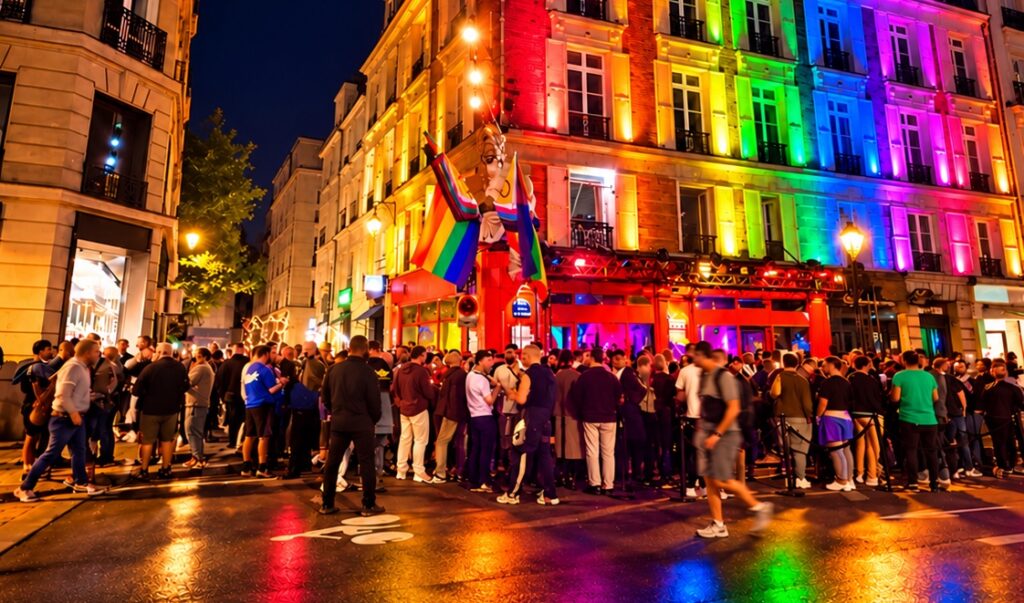
After a clash with the police prefecture during Paris Pride 2026, LGBT+ venues in the Marais, with the support of the city hall, are calling for a clear framework to party in the streets until 2 a.m. on Pride march evenings.
What time should the party stop in the Marais on Pride night? The question now comes up almost every year. After the Pride march on Saturday, October 3, the authorities asked the neighborhood’s venues to cut street music at 12:30 a.m. In late June, when Pride had been canceled due to a heatwave, bars had nonetheless been allowed to host DJ sets until 2 a.m. To justify this difference in treatment, the police prefecture told Têtu of a “context particularly crowded with events requiring a large mobilization of the forces of order”, between high school protests and the papal welcome, but also “numerous complaints from residents reporting noise nuisances”.
The decision sits even less well with the venues as it was announced at the last minute. “It was only the day before Pride that we learned that we would only have the right to make music in the street until midnight thirty”, laments Rémi Calmon, director of Sneg & Co, the LGBT+ businesses union. Yet the establishments need to organize well in advance. “We hire a private security company, we book DJs and call on the Red Cross… A Pride night isn’t organized from one day to the next”, exclaims Frédéric Hervé, owner of Cox, Freedj and Cactus.
“Sometimes you have to rebel a bit”
Nothing doing: at 12:30 a.m., “there were many officers telling us to stop making noise. We still continued, even if it meant getting a fine”, continues Rémi Calmon. “Sometimes you have to rebel a little when necessary. Especially since we had conflicting information”, added Frédéric Hervé.
For the City of Paris, allowing the events to continue until 2 a.m. seems like common sense: “It seems hardly applicable to ask people to vacate the street shortly after midnight on a Pride night”, says to Têtu the Mayor of Paris, Emmanuel Grégoire. “In London, Amsterdam or Berlin, no one would dare ask a bar to close its events at midnight on a Pride night!”, scoffs Frédéric Hervé. That is why Sneg & Co is calling for a clear framework that would allow venues to anticipate. This request is supported by the City Hall of Paris, which wants to formalize this arrangement for future editions, notably in view of the 2027 elections and a prefecture that could be even less conciliatory.
The conflicts do not stop at the question of hours. In late June, while Pride was canceled, the prefecture also deemed it appropriate to cancel the Marais pedestrianization order. “Tourists were already there to celebrate and the bars had authorization to open: as a result, there were a lot of people”, recalls Frédéric Hervé. Despite the crowds, the national police did not want to close car traffic, unlike the municipal police who did. “It was a mistake to think that because Pride was canceled people would not go out to party on a Saturday in June, when events were planned. Pedestrianization is a sensible measure for the safety of the neighborhood”, lamented then the mayor of Paris Centre, Ariel Weil.
More broadly, the union would like public authorities to take into account the specific nature of LGBT+ establishments. “It’s very hard to keep a community space alive. You only have to see the closures little by little. We need to be helped rather than spied upon to continue to remain a refuge”, continues Rémi Calmon. For 2027, LGBT+ establishments and the city hall hope to avoid another last-minute negotiation. With, in sight, the recognition of the neighborhood’s specificity and of its community establishments on Pride evenings.
