
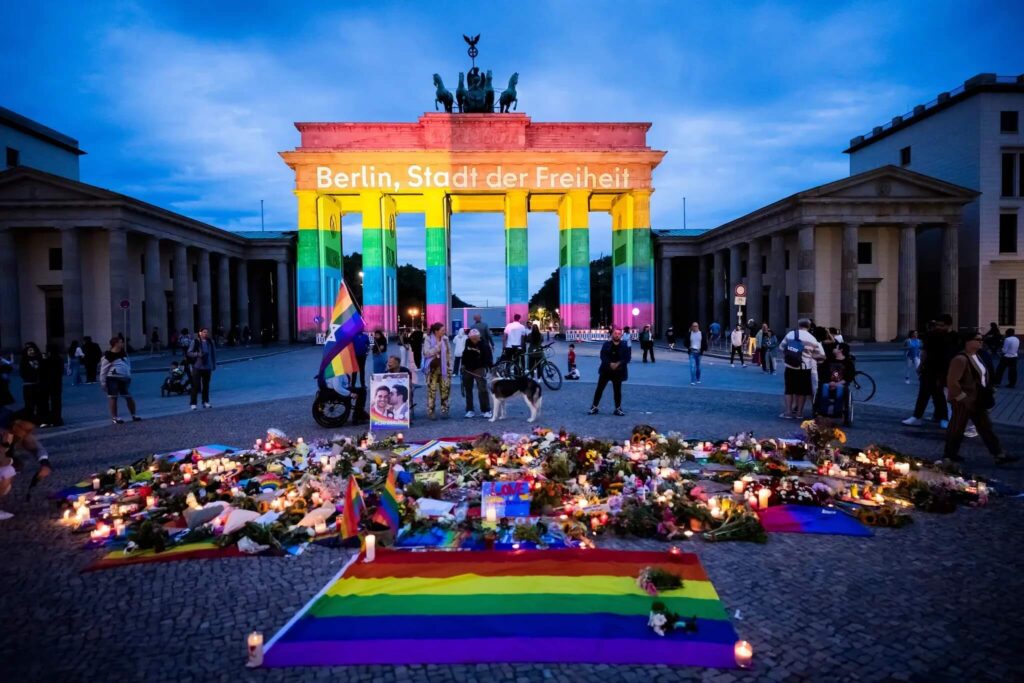
[Editorial to be found in the autumn magazine, at your newsstand or by subscription.] The attack on Berlin Pride did not only mourning the LGBT community. It revealed another danger: handing over to the far right the facts on which it thrives.
In the wake of the Islamist attack on Saturday, July 25, against Berlin Pride, the German singer Nyya spoke at a vigil in front of the Brandenburg Gate. She expressed the first thought that came to her when she learned that a car had plowed into the crowd, killing one person and injuring 29: “Please, may it not be a Kanake, may it be a white and Christian person.” Kanake, across the Rhine, is a racist insult reappropriated by people of Turkish or Arab origin.
“But that wasn’t the case”, she notes. Before phrasing it like an incantation: “That is where intersectionality comes in. Our struggles are not all the same, but, in moments like this, we support each other.” The video circulated widely and was presented to the right and to the far right as evidence of the left’s “woke” blindness: faced with an attack targeting LGBT people, the activist would be more worried about political instrumentalization than about the victims. That misses what she is saying. For by exposing the reasoning that, from the moment of the attack’s announcement, mingled with her fear, she anticipates the trap that lies ahead…
The flag burns…
In the hours and days that followed, LGBT organizations abandoned the task of naming what happened. On Sunday evening, SOS homophobie condemned an “LGBTIphobic attack” and described “an act of hatred against the freedom and existence of each one.” The ideological motivation is not mentioned. Inter-LGBT expresses its solidarity with the victims of the “attack” and calls for justice to “bring full light to this drama.” The word “attack” is no longer in use. In the statement published by Acceptess-T “in solidarity with the victims and against racist appropriations”, the LGBT reference disappeared from the title.
In Paris, on Monday evening, a first gathering “in solidarity with Berlin Pride” is called by the collective Revolutionary Feminists, at Place de la République, under the slogan “Against racist appropriations.” In a report, Libération takes up the banner: “When people ask what threatens them today, many also speak to us of the rise of the far right…” However, the front page of the daily will not mention at any moment the events that shook the German capital. A queer-killing attack against one of Europe’s major Prides will not find a place there.
On August 3, the AJL weighs in. The Association of LGBTQIA+ Journalists notes first: “We note that certain reflexes have a long life in France; many newsrooms have reused the term ‘gay pride’ used in several AFP dispatches.” The statement continues: “Above all, some media outlets have readily seized on the characterization of Islamist terrorist attack.” “The presumed affiliation of the author with the Islamic State seems to take precedence over the people he targeted during this attack and over the context in which it occurred. This choice says a lot,” declares the militant watchdog. Six days earlier, the German federal prosecutor’s office revealed the existence of a video in which the attacker’s pledged allegiance to the Islamic State group.
Good student, Mediapart follows the same path. To contextualize the event, the editorial team publishes an analysis devoted to “the sharp rise in violence targeting the LGBTQI+ community” in Germany. The angle chosen: “Beyond the attack and the mere fact of religious extremism, many authors are linked to the far right.” In the body of the article, a member of the inter-associative organizer of Berlin Pride testifies: “We all first thought it was a far-right attack.” Recovered from his surprise, Kai Bölle adds: “Islamism, like any religious extremism, is a threat to queer people. But this was not at all what concerned us concretely in recent months and years.” And the journalist illustrates the point: “In Bautzen, in Leipzig or in Magdeburg, Pride participants had to face parades of far-right demonstrators who came to protest against this march.”
The Great Amalgamation
The German far right has indeed seized the attack. As early as July 26, Kristin Brinker, president of the Berlin AfD, demanded the “end of uncontrolled mass immigration” and the “systematic expulsion of foreign criminals and Islamists, regardless of their possible protection status”. Islamism = Muslims = migrants = “great replacement”… “Help, Jeanne”: in Germany as in France, one knows the anti-immigration right’s refrain. In 2007, Nicolas Sarkozy already entrusted Brice Hortefeux with a ministry combining immigration and national identity, a pledge of his presidential campaign.
In France, the instrumentalization so dreaded of the Berlin attack takes on a nearly embarrassing turn. “Islamism is a totalitarian ideology that wages war against our liberties, against our democracies”, Marine Le Pen simply tweets before offering her “full and complete solidarity with the victims, their families and the German people.” Jordan Bardella’s thoughts push in the same direction: “The Islamist threat remains prevalent in Europe”, notes the president of the National Rally (RN), against “what they hate most in our civilization and what we hold so dear: freedom”. No need for amalgams anymore; simply saying “Islamism” is enough to appear above the fray. From the Two Sicilies to La Trinité-sur-Mer, one can hear the sound of ice cubes clinking.
To reap the fruits of the sequence, propagandist Damien Rieu can only bend down. “Abdul Ballout, Islamist, ran over the Berlin gay pride yesterday but you will hear from no LGBT association talk to you about it”, rejoices in advance the former spokesperson of Génération Identitaire. Then, mockingly: “The more the Islamists run over LGBT militants with a truck, the more LGBT militants defend the Islamists.” And there you have the far right able to pose as the true camp, the only one to say what everyone saw.
The year 2027 will mark the twenty-fifth anniversary of Jean-Marie Le Pen’s advancement to the second round of the presidential election. Two new qualifications of the family brand later, we should have learned the lesson. The RN flourishes on the silences of its opponents, as many public admissions of powerlessness. In other words, tell voters: move along, we have nothing to offer. Yet, fighting amalgamation does not mean invisibilizing realities but, on the contrary, distinguishing those that we refuse to amalgamate: Islam and Islamism, Muslims and Islamists, a population and a political-religious project.
POV Journalism
The Berlin attack raises a crucial question: what do we do with information that unsettles us? The war of narratives intensifies during an electoral period. By 2027, each side will have its facts to brandish and those it would prefer to hide. Every word will be suspected of serving a cause, every article urged to prove whom it benefits. The temptation will be great to judge information less by its truthfulness than by the political consequences of its dissemination.
The ethics of journalism is at stake here. We do not have the leisure to sort the facts according to their anticipated use. In the face of propaganda, our role is not to oppose a competing propaganda. It is not about claiming an absence of point of view (“POV”). Choosing an angle, choosing whom to give a voice to, is already looking at reality from somewhere.
For the stubborn, the compass is clear. We observe the world from LGBT lives and queer experience. A point of view does not authorize moving the facts to fit a frame. This profession imposes a code of ethics, but also procedures to implement it: information is verified, texts are proofread, sources confronted.
The journalism is a collective work. Its fundamental requirement has a name: the humility of the facts. It obliges us to renounce a phrase that overshoots them, to revise a judgment contradicted by reality, to heed colleagues’ objections. It will necessarily lead us to publish information that part of our readership would prefer not to read. At other times, it will be another part. The essential is that it is not always the same.
The reality does not need our agreement to exist. Life in democracy, however, requires that we can at least agree on the facts. That is the mission of journalism: to establish a common language to describe our present.
