
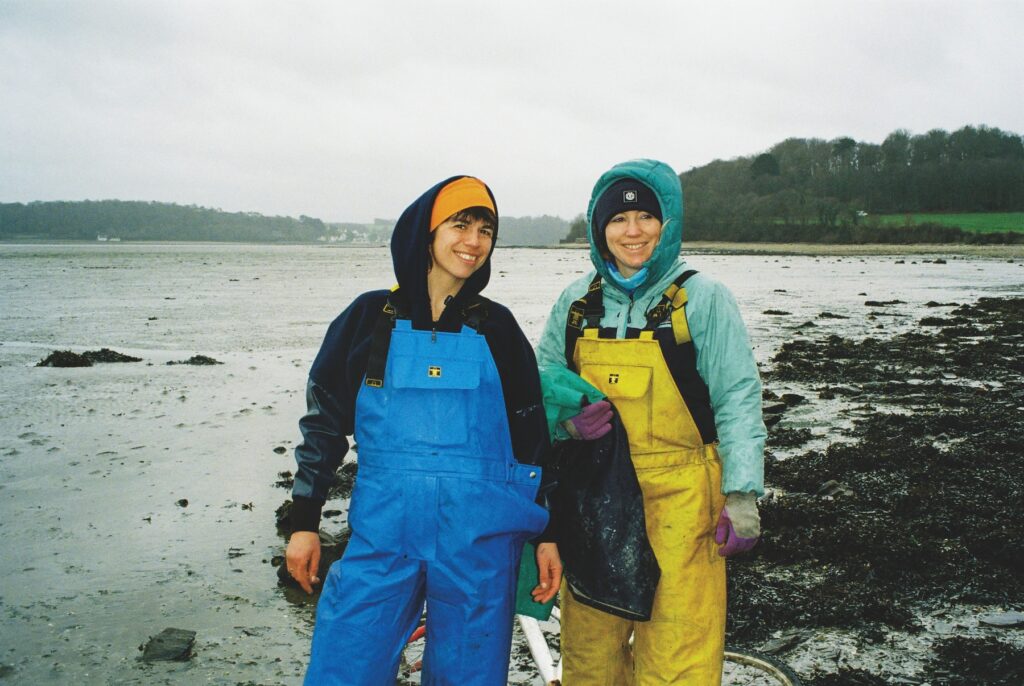
[Feature to be found in the Spring magazine, on kiosks or by subscription.] In Brittany, in the aptly named Finistère, Yuna and Mari-Soraya have found their freedom without abandoning their chosen lesbian family.
Photography: Yvelizra for têtu·
Between them, the important thing is the coastline. Settled in Logonna-Daoulas, in Finistère, about thirty minutes from Brest, Yuna and Mari‑Soraya devote a large part of their lives there. Born with their feet in the water just a stone’s throw away, the first already helped her parents at the markets. After schooling in Breton and sports studies that took her to Strasbourg, then Nantes, she naturally returned to her beloved coastline. “I’ve always loved fishing and being near the sea; it was just a matter of time”, she explains. In the meantime, Yuna took advantage of city life to come out of the closet.
Originally from Nantes, Mari‑Soraya chose training as a mariner, then in oyster farming, but it was clam fishing that brought her to Brittany to make a living. “It’s a pretty passionate job, quite tough when you come from the city, but it’s my choice. My only bosses are the moon and the barometer”, she argues, all smiles. In the same boat for five years, the couple of thirty-somethings has built here their home port, a warm stone house named “Ty Jeanne”.
The Subtle Charm of the Shellfish Farmer
In this line of work, women are rare. Kneeling on her bodyboard, a rake in hand, Mari‑Soraya speaks while scraping the sticky mud in search of clams: “I have trouble staying indoors and I love my moments of solitude. Here, I am calm, I listen to podcasts or the latest Rosalía album, while being cradled by the elements of nature…” She wouldn’t say no to some moments of laughter with colleagues, but she definitely prefers the incomparable peace of her working environment, evolving with the tides. Once her harvest is finished, she sells her shells directly to local restaurants. Lifting her head to take in the landscape, wet and misty of the mudflat, she summarizes: “I am very happy with my job and with my life as a lesbian in the Brest harbor [ed.].”
The two thirty-somethings met at Yuna’s parents’ oyster farm. “She knocked me out with her Guy Cotten coverall“, smiles Mari‑Soraya, when Yuna retorts: “And you caught my eye when you were fixing your Mobylette.” It was on a Plougastel beach that the obviousness asserted itself between these two hearts united by a passion for sport and shellfish. Today, Yuna has left the family business and put away her rubber boots. With her Dousik sport health structure (“dousik” means “slowly” in Breton), she gives sports and motor skills classes in care facilities. In parallel, within a club founded by her friend Virginie, she leads longe-côte sessions, that is, aquatic walking, the body half-immersed in the sea, along the beaches.
Far from the cliché of a rural life as a closet or isolation, the couple has built here their own Gouinistan. In a warm, local atmosphere, the two women organize “bingos locos” between performances, music and traditional dances. Activists, they donate the funds raised to community associations, such as Les Détraqueers, based in Brest, which helps LGBT+ refugees in the region. The result, the hyperactive duo jokes, “we are surrounded by queer people and a fair number of lesbians”.
More broadly, a queer life is organized in the region around solidarity and community events. Lesbian cafés have recently appeared thanks to Patoche, their 42-year-old queer goddaughter, just out of the closet. “A small territory brings people closer, notes Yuna. Most of our queer friends work in the fish market, carpentry or DIY. Our relationships revolve a lot around mutual aid.” Engaged in a MAP journey, they envision their family in the same spirit, marrying their desire for parenthood with their chosen family: “A couple of girlfriends is also in MAP, so we’ll lean on each other to raise our little ones. I feel I’m going to grow old surrounded by all these people”, rejoices Mari-Soraya, as happy as a clam at high tide.
