
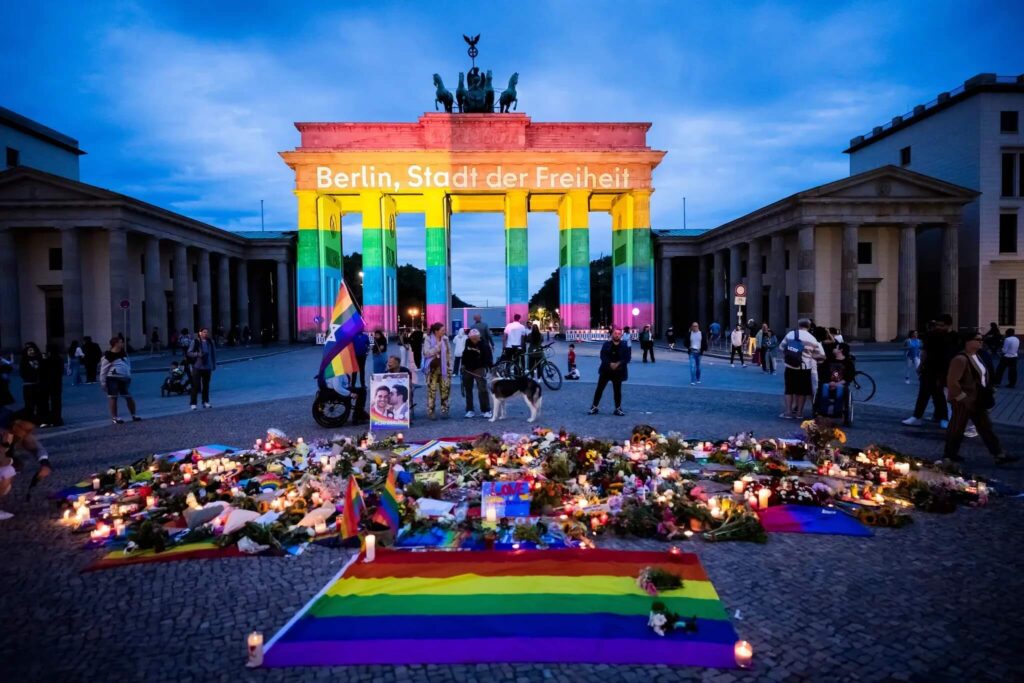
In 1990, the first Islamist attack documented against an LGBT venue struck a gay bar in New York. Thirty-six years later, Berlin Pride is targeted in turn. From Islamism to white supremacism, a look back at more than three decades of anti-LGBT terrorism.
Berlin, 2026: Pride attacked by an Islamist
Berlin’s Pride ends with an attack on July 25, 2026. In Tiergarten Park, where the festivities after the Pride march take place, a vehicle plowed into the crowd before its driver, fleeing, attacked marchers with a knife. The toll: one woman killed and 29 injured. Quickly identified, Abdul Ballout, 21, appears linked to the jihadist movement. In 2025, he had attempted to join the Islamic State (IS) in Syria before being arrested in Lebanon and then sent back to Germany. After 24 hours of pursuit, the terrorist was shot dead by the police. A video pledging allegiance to IS was found on his phone.
Oslo, 2022: an Islamist attack on the eve of Pride
On June 25, 2022, the eve of Pride in the Norwegian capital, a man opened fire near the London Pub, the country’s oldest gay bar. The toll: two dead and 21 injured. The attacker, arrested on the spot, is Zaniar Matapour, a 42-year-old Norwegian of Iranian origin. A few days before the attack, the terrorist had posted on Facebook the image of a rainbow flag in flames, accompanied by a call to kill LGBT people. Before carrying out the act, he sent a voice recording of allegiance to the jihadist group Islamic State (IS) to a friend. “The objective was to kill as many homosexuals as possible and to instill a sense of terror among homosexuals in general”, concluded, at his 2024 trial, the Oslo court which sentenced him to the maximum penalty: 30 years in prison, extendable indefinitely.
Bratislava, 2022: a gay bar targeted by a white supremacist
On October 12, 2022, in the heart of the Slovak capital, a man killed two patrons of the Tepláreň gay bar. The shooter is Juraj Krajčik, 19, son of a prominent member of the far-right party Vlasť. The police find him dead by suicide the following day. Blending white supremacism with antisemitic obsessions, his manifesto, published online before the attack, states his aim to end “the LGBT plague”. He notably claims the influence of Brenton Tarrant, the white supremacist responsible for the Christchurch massacre that left 51 dead in two mosques in New Zealand in 2019. On the day after the attack, the Slovak president, Zuzana Čaputová, offered apologies to the LGBT community: “I’m sorry that our society did not protect your loved ones.”
Colorado Springs, 2022: Club Q targeted by anti-LGBT hatred
On November 19, 2022, just after a drag show, a man opened fire at Club Q, the LGBT nightclub in Colorado Springs, in the western United States. Several patrons managed to neutralize the shooter. The toll: five dead and 18 injured. The 22-year-old shooter, Anderson Lee Aldrich, presents a troubled background marked notably by a violent father who, upon learning of the massacre, said: “I found out it was a gay bar. I was scared, I thought ‘oh no, is he gay?’ But he’s not. Phew!”. After having denied the anti-gay motive of his attack before the Californian justice system, the terrorist eventually acknowledged it before the federal justice system. He is sentenced to life imprisonment.
Carcassonne, 2018: the first jihadist homophobic attack in France
On March 23, 2018, Radouane Lakdim became known for the hostage-taking at the Trèbes supermarket, in the Aude (Occitanie), which ended with the heroic sacrifice of warden Arnaud Beltrame. But the killer’s murderous path began a few hours earlier in the Eagles’ Parking, in Carcassonne, a cruising spot known to the gay community. There, he shot a 61-year-old man and fired a shot into the head of another, Renato Gomes de Sousa, who survived miraculously. Once barricaded in the Trèbes Super U, Lakdim claimed his first victims: “I lit two faggots up there… I shot them in the head, without mercy.” He was shot dead by the GIGN. The trial of his accomplices would in 2024 confirm the homophobic nature of this first attack, considered the first jihadist anti-gay action carried out in France.
Orlando, 2016: the deadliest anti-LGBT attack in history
In the night of June 11 to 12, 2016, Omar Mateen, 29, opened fire at Pulse, a gay nightclub in Orlando, Florida, where about 350 people were gathered. The terrorist took several patrons hostage in the restrooms and exchanged gunfire with law enforcement before being shot dead in the early hours. The toll: 49 dead and 53 injured, making it then the deadliest shooting in American history. During the attack, Omar Mateen pledged allegiance to the Islamic State (IS). From the White House, Barack Obama denounced “an act of terror and an act of hate”. Donald Trump, then a candidate for re-election, chose another register: “I appreciate the congratulations for having been right about radical Islamic terrorism”, he wrote on Twitter.
Jerusalem, 2005 and 2015: two Prides targeted by an ultra-Orthodox
On June 30, 2005 in Israel, during the fourth Jerusalem Pride march, Yishai Schlissel, a 29-year-old ultra-Orthodox Jew, stabbed three marchers. Questioned, he claimed his action “in the name of God” and stated: “We cannot have such an abomination in the country.” Condemned to ten years in prison, he reoffends a few weeks after his release. On July 30, 2015, armed with a knife, he attacked Jerusalem Pride again and injured six participants. Among them, Shira Banki, 16, who was marching with friends, died a few days later from her injuries. Yishai Schlissel is this time sentenced to life imprisonment.
London, 1999: a gay bar targeted by a neo-Nazi
In April 1999, David Copeland, a 22-year-old neo-Nazi terrorist, carried out over three weeks a bombing campaign targeting London’s minorities. After Brixton and Brick Lane, where he targeted Black and Bangladeshi communities, he struck on April 30 at the Admiral Duncan, a Soho gay bar. His nail-studded bomb killed three people and injured 79. A former member of a neo-Nazi group, Copeland explains in custody that he wanted to “spread fear, resentment and hatred to trigger a racial war”. In his room, investigators found a Nazi flag and press clippings about his own attacks. Convicted of three murders, he was sentenced to six life terms.
Atlanta, 1997: a lesbian bar targeted by a Christian extremist
On February 21, 1997, the Otherside Lounge, a lesbian bar in Atlanta, the capital of Georgia in the southern United States, was the target of a bombing attack. While about a hundred people were inside the establishment, an improvised device hidden outside exploded, projecting nails and debris into the crowd and making five wounded. A second bomb found nearby was defused. The attack was attributed to Eric Rudolph, a far-right Christian fundamentalist activist already responsible for the 1996 Olympic Park bombing in Atlanta and attacks against abortion clinics. Arrested in 2003 after years on the run, he acknowledges the facts and explicitly claims to have targeted the lesbian bar to send “a powerful message in protest against tolerance and Washington’s support for the homosexual political agenda.”
New York, 1990: the first anti-LGBT attack was Islamist
In the night of April 28, 1990, an artisanal bomb exploded at Uncle Charlie’s, a gay bar in Greenwich Village, New York, killing three people. The attack remained unsolved for five years. In 1995, during the trial of a jihadist cell planning to strike several New York monuments, investigators attributed the attack to El Sayyid Nosair. According to the prosecution, he had chosen the establishment “to protest against homosexuality for religious motives”. Already convicted for the murder of Rabbi Meir Kahane in 1990, Nosair was found guilty of terror conspiracy and sentenced to life in prison. The Uncle Charlie’s attack is regarded as the first Islamist attack documented against an LGBT venue.
