
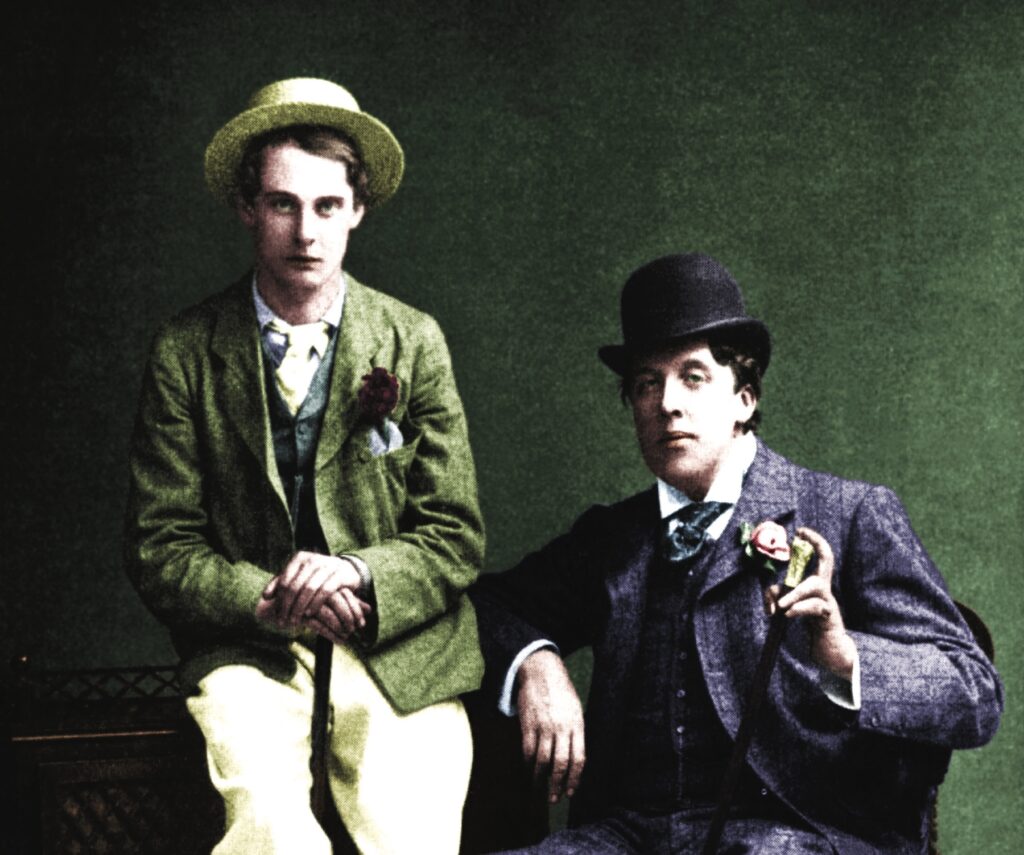
[Story to be found in the summer issue, at your newsstand or by subscription.] Accused of sodomy by the father of a lover, Oscar Wilde sues him for defamation. But in Victorian England, the trial quickly turns against the writer, opening the way to his own conviction for homosexuality.
It is the story of a trial lost from the outset. On 3 April 1895, Oscar Wilde is in court, but not yet on the defendant’s bench; he is prosecuting the Marquis of Queensberry for defamation. The latter is none other than the father of the writer’s lover, Alfred Douglas. The subject of the dispute: the aristocrat left at the door of the fashionable London club frequented by the author a card intended for him. “For Oscar Wilde posing as a somdomite“, one reads there. The spelling error is original.
In Victorian England, the accusation of homosexuality is far from trivial. If sodomy has not been punishable by death since 1861, relationships between men can still lead to prison. Queensberry did not content himself with that card; he also sent letters to the writer’s close associates at the height of his fame and attempted to disrupt a production of The Importance of Being Earnest, a bouquet of vegetables in hand. When Oscar Wilde brings suit, he evidently thinks he can win the jurors’ hearts with his witticisms. But the trial quickly escapes him and turns against him.
Très vite, sa relation avec Alfred Douglas se retrouve au centre des débats. L’auteur tente de présenter leur lien comme une amitié exaltée, presque purement artistique. Une lettre adressée au jeune homme est lue à l’audience : “Mon garçon à moi, ton sonnet est charmant, et c’est une merveille que ces lèvres vermeilles, en forme de feuille de rosier, qui sont les tiennes soient aussi bien faites pour la musique des mots que pour la folie des baisers.”
Creating Beauty
When Queensberry’s lawyer asks him whether such a letter seems “proper”, the writer refuses to answer on moral grounds: “You could just as well ask me if Lear is proper, or a Shakespeare sonnet… It was a magnificent letter. It had not been written with the aim of respecting conventions, but with the aim of creating beauty.” In a society that criminalizes desire between men, he chooses to publicly defend an aesthetic and amorous conception of it. The gesture has panache; the personal risk is insane.
For demonstrating his immorality, the Queensberry camp rummages through the author’s writings. His aphorisms published in The Chameleon are read aloud in court. One finds notably this sentence: “Perversity is a myth invented by decent people to explain the strange attraction others exert.” Questioned about the potentially scandalous influence of these texts, Oscar Wilde responds as an artist, more than as a defendant. “I am concerned only with literature, that is, with art.”
As the trial progresses, the gap between Victorian morality and the artist’s stance widens. When the Queensberry’s lawyer cites an early version of the Portrait of Dorian Gray to ask him whether he has ever felt, like his character, “a wild adoration for a beautiful youth of the male sex”, Wilde again prefers irony to prudence. “I have never felt adoration for anyone, except myself” he declares, provoking roars of laughter in the courtroom. Indeed, the case exposes the hypocrisy of a society that tolerates certain relationships as long as they remain hidden. And the writer is an ideal target: famous, provocative, his dandyism and visibility make it impossible to maintain Victorian pretenses.
Tragic Panache
The trial tips when the testimonies of young men recounting their meetings and the gifts he gives them accumulate… His lawyer does try to remind that Oscar Wilde is married and the father of two children. Nothing works. On the third day of the trial, Queensberry is acquitted. The judicial machinery is now turned against Wilde. Sent to the authorities, the elements gathered against him earn him charges of “gross indecency”. He still has time to leave the United Kingdom, but chooses to stay. On 25 May 1895, Oscar Wilde is sentenced to the maximum penalty, namely two years’ hard labor.
But why pursue such a risky case? Author of Oscar Wilde, or the ‘destiny’ of the homosexual, Robert Merle analyzes this question in 1965 during a television interview preserved by INA. He first discusses the influence of Lord Alfred Douglas who, in his hatred for his father, would have pushed the writer to attack him. The French novelist also calls on his psychology: “Wilde at that moment had a kind of vertigo of the abyss; he was a man suffering from a great self-punishment complex.” Unconscious or suicidal, the writer would have refused, whatever the case, to speak the moral language of his accusers. Faced with a society that demands silence and shame, he opposes irony and art, in a form of tragic defiance. Having lost everything, his fortune as well as his family, he goes into exile in France after his release in 1897. He dies three years later in Paris, at 46.
