
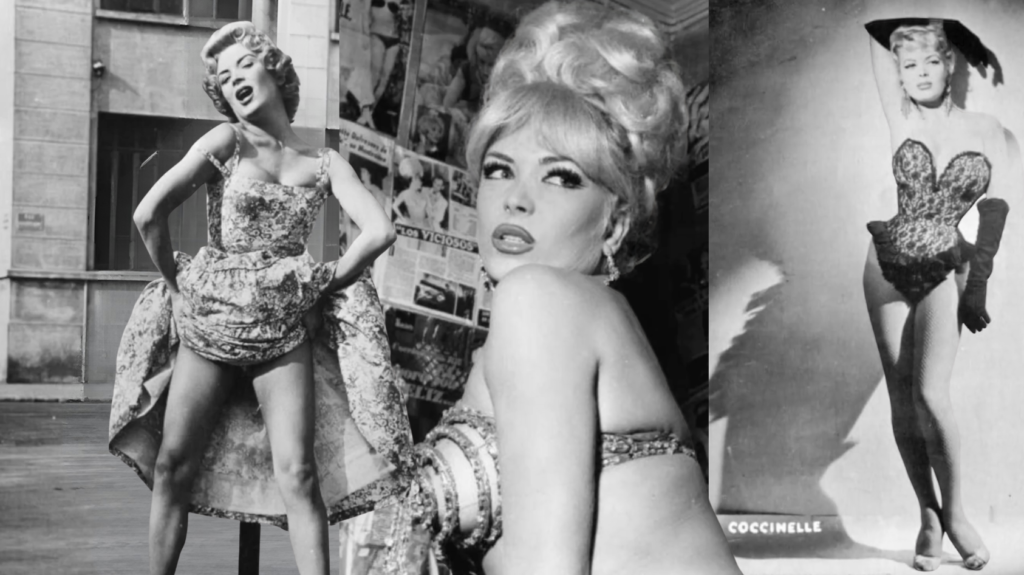
Died on October 9, 2006, Coccinelle was one of the first major French transgender figures. Twenty years later, her legacy remains very much alive.
Coccinelle died twenty years ago, on October 9, 2006. A star of Paris’s travesti scene of the 1950s and one of the first transgender women to gain international celebrity, she left her mark through her career, her transition, and her media exposure. Two decades after her passing, her legacy continues to inspire new generations. An exhibition entitled “Coccinelle, chercher la femme” presenting her stage outfits and accessories is dedicated to her at the Mairie du 9 ème in Paris until October 29.
“I am called Coccinelle like the ladybird. Just like her I have wings that carry me wherever I want.” In the Paris of the 1950s, Coccinelle drew eyes everywhere she went. Platinum blonde, pin-up silhouette and an aura worthy of her idols, Marlene Dietrich and Martine Carole, she fascinated as much as she intrigued. She would later recount that, in restaurants, some maitre d’hôtels could not resist whispering to clients: “Do you see the blonde over there? It’s a man.” Incredulous, many then came to see her on stage. “That made me known at a dizzying speed, without a manager or publicity,” she recalled in 1996 on France 3 Marseille.
Before becoming one of the stars of the Carrousel of Paris, Jacqueline Dufresnoy grew up in the 18th arrondissement of Paris, where she was born on August 23, 1931. Assigned male at birth, she recalls having very early found in her mother’s clothes and high heels a way to approach the person she knew herself to be. As an adult, she began taking Distilbene, a synthetic estrogen, to feminize her body.
Beast of the Stage
It is at the beginning of the 1950s that her destiny shifts toward Montmartre. She pushes open the door of Madame Arthur, a cabaret where many travestied artists performed at the time, and soon adopts the name Coccinelle. Her physique, her sense of the stage and her glamour quickly opened the doors to the Carrousel de Paris, one of the high points of Parisian nightlife with the evocative slogan: “The 100 most beautiful transvestites in the world.”
During her more than forty-year career, she mixed singing, cabaret numbers and spectacular costumes, and toured the world. Her fame rested first, she did not hide it, on the curiosity sparked by her identity. But Coccinelle gradually turned that curiosity into an unprecedented visibility for a trans woman.
“I don’t call them transsexuals; I call them women of the year 2000.”
In 1958, she went to Casablanca to undergo vaginoplasty. The following year, with the help of her lawyer, a certain Robert Badinter, she obtained the modification of her civil status and officially became Jacqueline Charlotte Dufresnoy. Then, on March 16, 1962, she married sports journalist Paul Bonnet, first at the town hall of the 17th arrondissement of Paris, then at the Saint-Jean Church in Montmartre. The event, at once a media spectacle and a scandal, attracted as many photographers and journalists as the curious, some ill-intentioned, armed with tomatoes.
At a time when transgender people remained almost invisible in the public space, Coccinelle thus became one of their few faces known to the general public. Without promoting the militant discourse that would shape in the following decades, she contributed, by her mere media presence, to making a transgender existence visible and possible.

A pioneer who became a matriarch
Twenty years after her death, it is precisely this place that those who align themselves with her legacy today remember. In 2017, during the inauguration of the Coccinelle promenade, on Boulevard de Clichy, her friend and former stage partner, Bambi, recalled what made her an “absolute reference”: “With her youth, her beauty, her talent and above all her intimate certainty, her perseverance and also her courage, she ultimately triumphed over everything. She understood very early that the dark part within her was nothing to be ashamed of. On the contrary, it was what she carried as the noblest and most fertile to cultivate.”
This legacy is also found on contemporary stages. In June 2026, La Briochée thus embodied a 1950s Coccinelle during the tribute show “to the girls of the Carrousel” by the Sasha Colby’s Dolls Folies at the Folies Bergère. “Coccinelle embodies the ‘possible’ for trans women, against all odds,” she tells Têtu. “The first transgender woman famous across the world, the first to legally marry, the first to speak about the transgender cause on television at prime time, and all while being respected as an artist and as a person.”
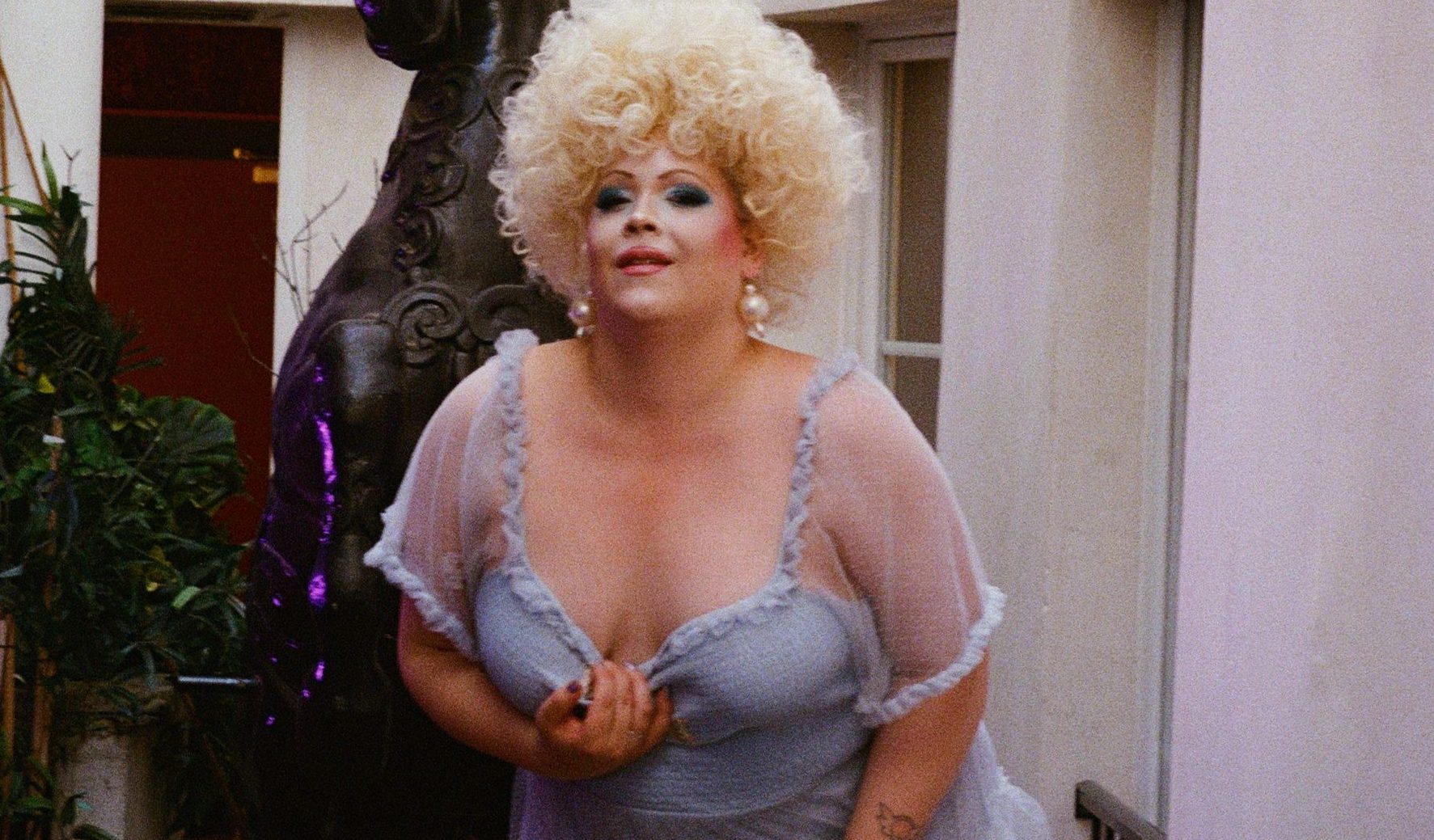
The same lineage also appears with Fluffy Bidule. For her “Pop Culture” look in Drag Race France season 4, the artist chose to recreate the outfit that would have given Coccinelle her stage name when she joined Madame Arthur in 1953: a red polka-dot dress, accompanied by a hat and a veil. The shoot was done at the cabaret itself, as if to close the loop.
View this post on Instagram
Seventy years after her debut, Coccinelle is therefore no longer merely a figure of Paris’s nightlife in the 1950s. She has become a reference claimed by a new generation of trans and drag artists. A legacy that La Briochée summarizes by echoing the pioneer’s own words: “Yes, Coccinelle. We are indeed the women of the year 2000, and even more so.”
Today, her last husband, Thierry Wilson, alias Zize Dupanier, a transformist artist, dusts off the stage costumes, jewelry and photos from Coccinelle’s private collection to present them to the public at the retrospective at the Mairie of the 9th arrondissement in Paris until October 29. A faithful companion until the end, Thierry stands as guarantor of Coccinelle’s memory. He wrote the preface to the graphic novel Coccinelle, chercher la femme by Gloria Ciapponi and Luca Conca, published in 2024 by La Boîte à Bulles. He recalls his wife in these terms: “Coccinelle is and will forever be a symbol, an icon and a hope for all beings born in a ‘wrong body’. She will forever remain that insolent beauty, this epicurean who chewed life with gusto, living each day as if it were the last.”
