
[Article to read in the autumn issue, available at your newsstand or by subscription.] France brings to the United Nations a resolution for the universal decriminalization of homosexuality. But the initiative faces an unexpected opposition: from a portion of LGBT+ rights organizations.
Opening his mail, Emmanuel Macron must have been surprised by a letter dated June 24. “We respectfully request the French government not to present a resolution on the decriminalization [of homosexuality] at the United Nations Human Rights Council”, he can read there. The surprise lies in the signatories list: not reactionary organizations, but 140 associations defending LGBT+ rights around the world, including the International Lesbian, Gay, Bisexual, Trans and Intersex Association (ILGA World), Human Rights Watch (HRW) or the Francophone international alliance Égides.
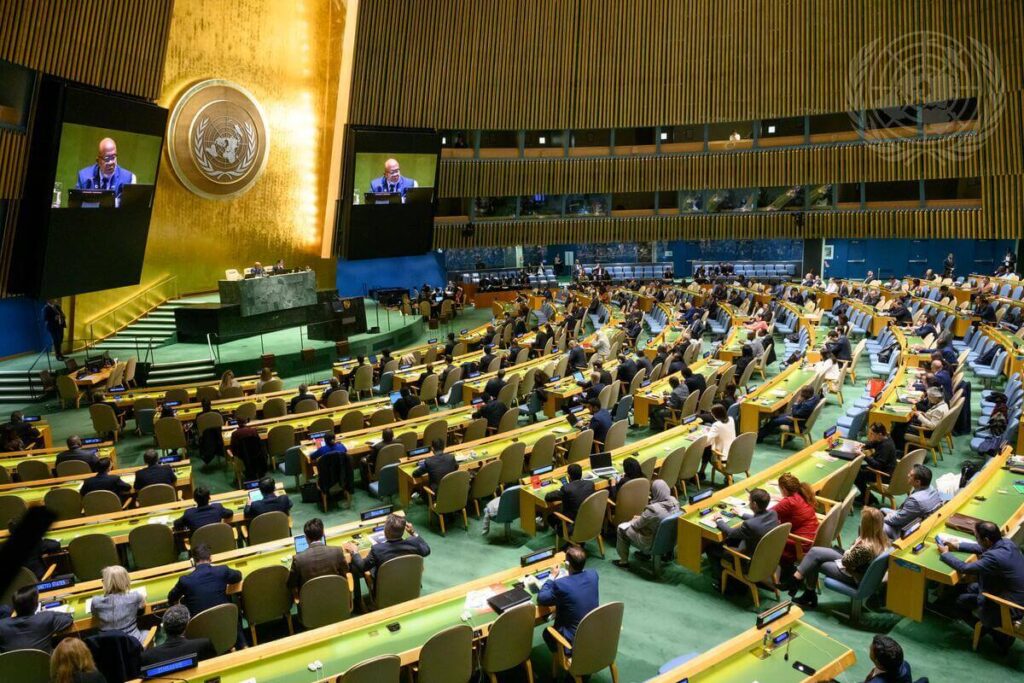
Yet the initiative marks an important milestone in the battle for the universal decriminalization of homosexuality. Four years after the appointment of Jean-Marc Berthon as ambassador for LGBT+ rights, France intends to submit a proposal to that effect to the Human Rights Council. Time is pressing: its mandate on the Council ends on December 31. The last ordinary session before this term takes place in Geneva from September 7 to October 7: thus it is the final opportunity for France to have it adopted. The 47 member states must debate the state of human rights and adopt texts to be transmitted to the United Nations General Assembly. “Despite setbacks in some countries, I believe there is today, within the Human Rights Council, a majority ready to vote such a resolution”, says Jean-Marc Berthon.
The message and the messenger
According to our information, the French draft rests on three articles: the first states that the criminalization of homosexuality is contrary to human rights; the second calls on countries that practice it to decriminalize; the third condemns the violence suffered by homosexual people. Simple, basic.
A non-binding text: its adoption would not legally obligate any state to decriminalize homosexuality. But a resolution can weigh on the evolution of national rights, serving as a reference for activists, lawyers and judges. When India’s Supreme Court ruled its criminalization unconstitutional in 2018, it drew on several international texts to establish the emergence of a global consensus. Similar references were mobilized during the decriminalization in Belize in 2016 or Botswana in 2019.
Why, then, do human rights organizations ask France to withdraw? “When you take this kind of initiative, you must be aware of the risk of a backlash for local associations and populations”, says Shakhawat Hossain, also known as Rajeeb, head of advocacy within the ILGA World federation. “Sometimes humanitarian work requires discretion and advocacy is more effective when it advances quietly, depending on local specifics”, adds Larissa Kojoué, a researcher in HRW’s LGBT rights division.
Another fear invoked: that the French origin of the resolution would provide arguments to its opponents. “It would be harmful for such a resolution to be perceived as a lesson from the North to the South”, argues Shakhawat Hossain. “In a context of anti-Western tension, homosexuality is associated with Western values and France with its past as a colonizing country”, notes Michaël Arnaud of Égides. Even the UN’s independent expert on sexual orientation and gender identity, Graeme Reid, urges caution: “The fundamental question is whether the conditions are conducive to such an initiative and if a poor choice of timing, or spokesperson, could render it counterproductive.”
The backlash argument, however, is far from universally supported. “It’s lunacy, retorts Louis-Georges Tin, founder of the Idaho committee, the origin of World Day Against Homophobia. No one has ever found a single example of a country speeding up the penalization of homosexuality because the United Nations condemns it. Should we also curb the fight for women’s rights to avoid offending anyone?” The academic, on the contrary, defends a two-level strategy: “In diplomacy, effectiveness lies in stating principles within international bodies and encouraging their adoption through bilateral relations.”
A victory for the reactionary lobby?
The opposition of the 140 associations does not exhaust the debate within the international LGBT+ movement. The Idaho-France Committee circulated a counter-letter, signed by 110 associations, including many African groups. “If France retreats today, as everyone knows this text is in the works, it would give a huge victory to our opponents, who could redouble their energy to penalize or over-penalize, feeling that the progressive camp is in a position of weakness”, they warn.
France is not embarking on its first attempt. In 2008, under Nicolas Sarkozy’s presidency, the Secretary of State for Human Rights Rama Yade, together with the Netherlands, issued a declaration calling for the universal decriminalization of homosexuality. Unlike a resolution, the text does not have to be put to a vote by a UN body: states are invited to join it individually. More than 60 countries do so, including Brazil, Israel or Japan, but not the United States of George W. Bush. Three months later, the Obama administration reversed that position and offered its support to the text.
To counter the initiative, Syria presented a rival text, supported by 59 countries, including many members of the Organisation of Islamic Cooperation: Saudi Arabia, Egypt, Qatar, Algeria, Morocco, Cameroon, Ivory Coast, Uganda or Senegal. This text asserts that the notion of sexual orientation covers “a broad range of personal choices that go far beyond the interest of the person to have sexual relations with normal, consenting adults”. Fearing a “social normalization” of homosexuality, its signatories go so far as to warn against “the legitimization of numerous deplorable acts, including pedophilia”.
Meanwhile, the landscape has nonetheless evolved. In 2008, nearly 80 states criminalized homosexuality. Today, 65 criminalize consensual same-sex relations, of which seven still impose the death penalty. A real advance, which leaves about a third of UN member states to persuade. Eighteen years later, the arguments have changed little. From Vladimir Putin’s Russia to Senegal’s Pastef, from Viktor Orban’s Hungary to Donald Trump’s United States, reactionary movements have since extended their campaign against LGBT+ rights to the global stage. Facing opponents who wage their battles in international forums, should we renounce carrying ours there? That is the question.
