
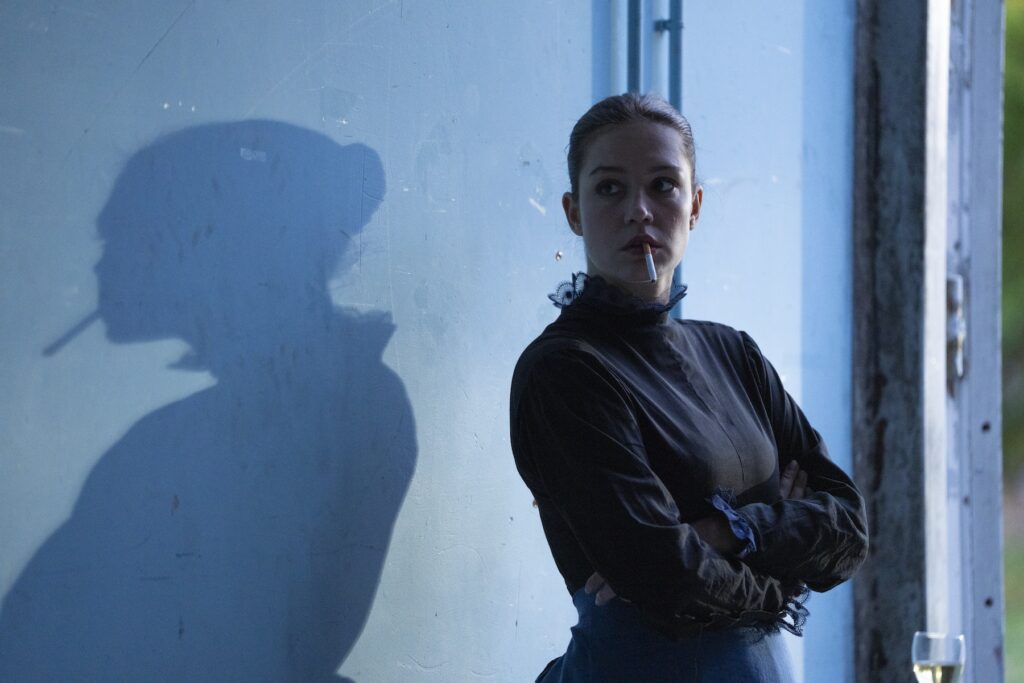
[Interview to be found in the autumn issue, at your newsstand or by subscription.] Three years after Je verrai toujours vos visages, Adèle Exarchopoulos reunites with director Jeanne Herry in Garance in cinemas this Wednesday, September 23. She plays an actress grappling with alcoholism who discovers her attraction to Pauline, played by Sara Giraudeau.
At only 32, she has one of the most remarkable CVs in French cinema. The first time Adèle Exarchopoulos was in an interview in têtu·, it was in 2013 for La Vie d’Adèle, Abdellatif Kechiche’s film that earned her a César for Best Newcomer and, with Léa Seydoux, made her the first actress to personally receive the Palme d’Or. Since then, she has danced with genres, from Règne animal or BAC Nord to Quentin Dupieux’s films. By 2028, she will even act in Park Chan-wook’s next South Korean western.
Her first collaboration with Jeanne Herry, in Je verrai toujours vos visages, brings her a second César, that of Best Actress in a Supporting Role, in 2024 – the year also of her wild success with Gilles Lellouche’s love film. For their reunion, the director entrusts her with Garance, a film almost entirely centered on her. Present in every scene, Adèle Exarchopoulos accompanies her character in all aspects of her life: her career as an actress, her alcoholism, and the discovery of her attraction to women. After La Vie d’Adèle and Les Cinq Diables, it’s the third time she portrays a woman attracted to women.
What have you put of yourself into this new character?
The passion for acting and a somewhat more mature conception of love, which I discovered over the course of my life. When you’re young, you’re not always entirely yourself with the other person. You expect grand proofs of love, you cling to fantasies. In the story between Garance and Pauline, there is something absolute: their presence beside each other is enough. As you mature, you realize that giving someone time already constitutes a very beautiful proof of love.
We follow Garance in all the dimensions of her life, you are present in every scene. How do you prepare for a role of such magnitude?
I knew the preparation would be a mountain. With a limited time, we had to make both her alcoholism and her love story or her profession as an actress credible, with all that entails of passion and struggle. To understand the illness, Jeanne [Herry] allowed me to enter addiction centers, where I attended women-only support groups. Everyone listens to one another and no one judges. It truly moved me.
Pauline reacts in a rather unexpected way to Garance’s alcoholism. She never blames her and she doesn’t reject her either…
I myself sometimes found her too kind or passive. But Jeanne insisted that she be that way, and I think she was right. The surrounding people must find their rightful place, which is no easy matter. You must neither pose as a savior nor recreate, for the sick person, another form of dependency.
The film shows that the party is a space of temptation but also a refuge. Were you aware of that?
For many people, the party is a place of peace and understanding. In Garance’s case, it is also a space of revelation, where she explores a new part of her identity. But the party is also a crowd in which it’s easy to drown.
Garance discovers her attraction to women without painful second thoughts…
We need films that show the sometimes winding path toward acceptance, but we also need to represent queer characters in narratives where their orientation is taken for granted. Yet, when I kiss Sara Giraudeau in the middle of Montparnasse station, I clearly see in people’s eyes that it isn’t perceived the same way as if I kissed a man. I enjoy kissing a girl as much as a boy, even more a girl when it’s Sara or Léa Seydoux.
Have you always been so relaxed about it?
The discovery of my sexuality has never been an issue. At 16, I come back from high school and my father asks me if there’s someone in my life and if I want to invite her to lunch. I tell him her name is Christina, that she’s the prettiest girl in the school, and that I’m in love with her. He simply says: “Bring her tomorrow.” I’m aware that it’s a privilege. La Vie d’Adèle brought me to meet people who didn’t have this privilege.
Playing a queer character, is it a particular responsibility?
I don’t make any difference in my approach to these roles. But when La Vie d’Adèle came out and we had to be surrounded by bodyguards to attend the premiere in Russia because our presence caused trouble, I realized it is a real responsibility. I accept it with pride. I will always stand on the side of love. When people tell me they dared to come out after watching La Vie d’Adèle, suddenly everything makes sense.
Since you mention La Vie d’Adèle, you should know the film divides among lesbians…
Of course, people talked to me about it as soon as it came out. I can understand that the way the sex was filmed disturbed some viewers. Yet, when someone tells me that women don’t make love like that, I block a little. I doubt we all have the same way of approaching sexuality.
And you, if you had to choose an actress with whom to embody a great romance, who would you choose?
Perhaps Sandra Hüller orSusan Sarandon. Or Alexa Demie, from the series Euphoria!
Finally, a lesbian work that left a mark on you?
The L Word, but that’s as expected an answer. Otherwise, I’d say My Summer of Love with Emily Blunt, or Boys Don’t Cry, which moved me. It leaves a rather indelible memory.
