
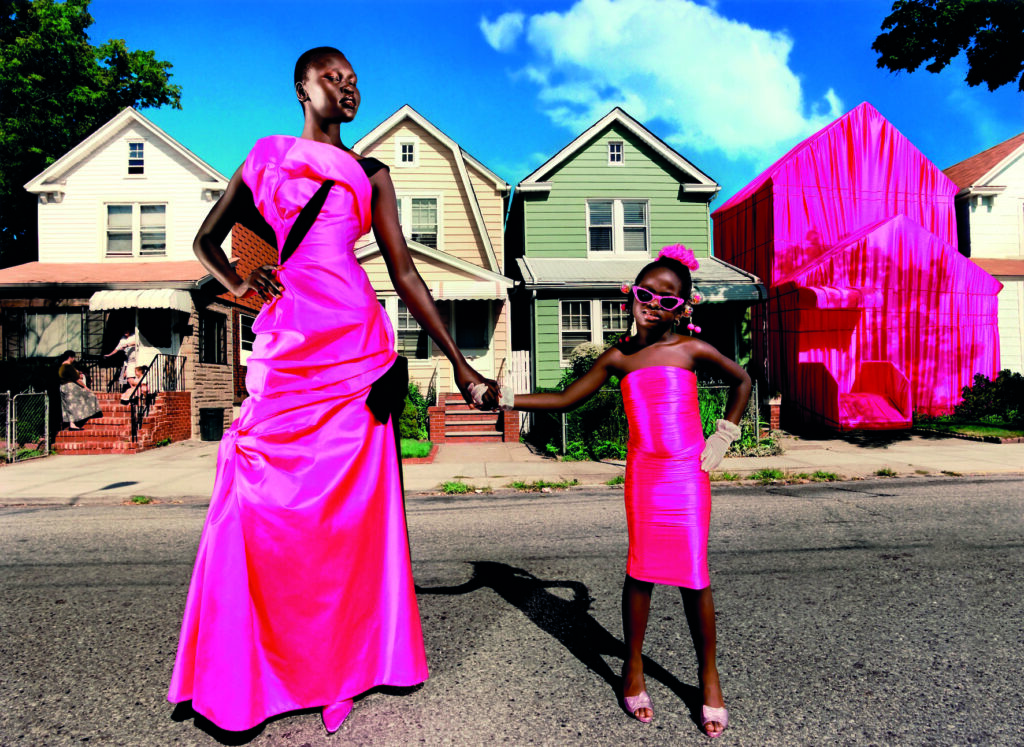
[Interview to be found in the autumn issue, at your newsstand or by subscription.] Revealed by Andy Warhol, David LaChapelle has made kitsch a language and fashion photography a pop theatre where celebrities, religion, social critique and queer culture meet. On the occasion of the retrospective dedicated to him by the Portrait(s) festival, running until October 4 in Vichy, the 63-year-old American photographer looks back at the origins of his aesthetic.
Did you dream of art galleries? How did you become a fashion photographer?
When I started, my heroes were Richard Avedon, Helmut Newton or Jean-Paul Goude. I wanted to exhibit in the East Village galleries in New York. But in the early 1980s, nobody was really buying photographs. At 17, I joined Interview Magazine, Warhol’s magazine. This encounter opened the doors to the press. I worked for The Face, British Vogue, Vogue Paris… Yet I always felt a bit like an outsider there. As a child, I already couldn’t find my place among others. Some people hide their femininity, their homosexuality or what makes them different better than others. I, on the other hand, was mainly trying to push boundaries.
Your photography immediately stood out in the fashion world. What did you bring that was new?
At the time, fashion was photographed on beaches or in sumptuous locations. I took haute couture into shopping centers, at McDonald’s or at Euro Disney. Others were doing grunge, dark and desaturated images. I did disco. I used bright colors and I embraced kitsch. I was trying to reveal the beauty of a popular America that many looked down upon.
You have said that your shift to color was linked to the AIDS epidemic. That seems counterintuitive…
My first love died in 1984. I was convinced I was going to die too. I was 21, he was 24. People disappeared overnight. I wondered where all that energy was going. What becomes of the vitality of a 24-year-old man, a magnificent dancer, full of life and laughter? I needed to give shape to this vanished energy. The real turning point came when I finally agreed to get tested, in 1996. For a long time, I had refused. I was an ACT UP activist in New York and, honestly, we sometimes felt that we knew more than some doctors.
You have photographed Lady Gaga, Elton John, Amy Winehouse, Michael Jackson… What distinguishes a star from an icon?
It is time that decides. Jeff Buckley or Amy Winehouse had very short careers, but an enormous impact. Kurt Cobain too. And then there are those whose influence spans decades. Today, the words “legend” or “icon” are used for all sorts of things. In the end, they have somewhat lost their meaning.
Christian iconography runs through your work. How do you reconcile faith and homosexuality?
I refuse to let religion be defined by its political co-optation. I prefer to listen to the teaching of Christ, rather than some misogynistic or homophobic interpretations. My faith has never been shaken. I have always believed in a God of love. We were created this way. We are perfect as we are.
