
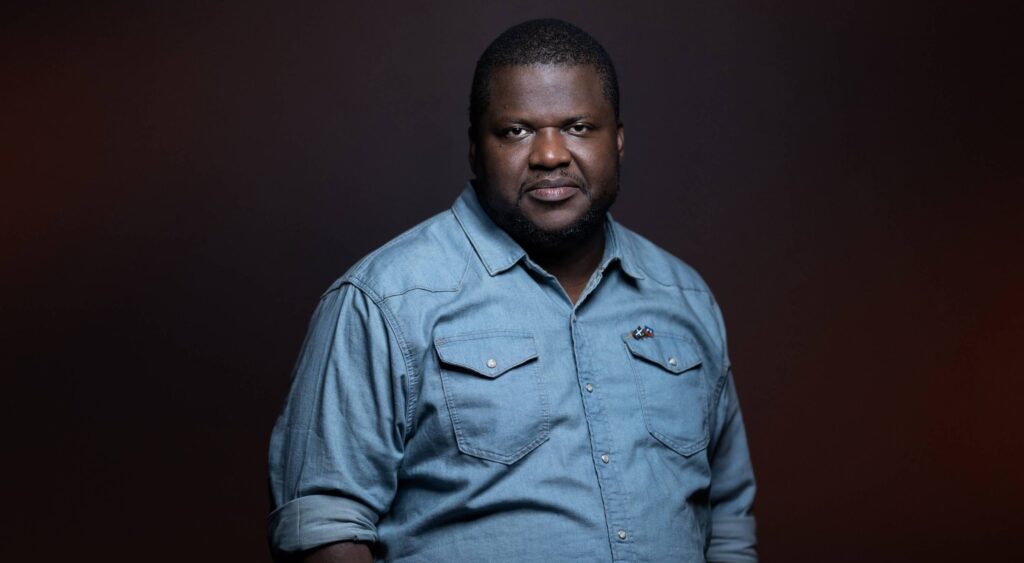
Accused of having written his novel That Was It or Die with artificial intelligence, writer Thélyson Orélien denies it. Behind his case looms a far more vertiginous question: since when do we entrust a machine with determining what still falls under human creation?
Five minutes ago, artificial intelligence was supposed to kill us all, perhaps even before the decade ends. Now it is empowered to decree who is a writer. The Quebecois author of Haitian origin, Thélyson Orélien, is thus accused of having written his novel published at the end of August, That Was It or Die (Grasset), with an AI, based on a software meant to distinguish human speech from machine speech. The designers of these systems nevertheless parade through the media to warn us about opaque, probabilistic technologies capable of reproducing the biases with which we nourished them, or even hallucinating… But that someone claims to recognize the prose of a fellow writer and, suddenly, his verdict carries weight! In short, the AI could kill us over a misunderstanding, but please trust it: it knows how to recognize a writer.
“Doubt is allowed”, concludes the newspaper Libération, which puts the subject on its front page this Wednesday, September 23. In our field, doubt is even fundamental. But here, who instituted it? Until now, That Was It or Die has been one of the revelations of this rentrée littéraire: an object of laudatory criticism and effective word-of-mouth, the novel is selected for several of the autumn’s major prizes and has already received, not later than this Monday, the Fnac Novel Prize. Then “Balance ton Claude” (named after the ’AI assistant designed by Anthropic), an anonymous account created on X in June, submits several excerpts to Pangram, a software for detecting AI-generated texts. The displayed verdict is spectacular: “100% AI”. The experiment is repeated on older texts by Thélyson Orélien, which the software now identifies as human. Published by “Balance ton Claude”, these results circulate, the press seizes on them and, within a few days, the novelist previously celebrated is compelled to explain himself.
General Doubt About Literature
The case presents a dark lexical irony. For a long time, when a writer was suspected of not being the author of the lines he signed, people said he had a “nègre” (a ghostwriter). The word, today abandoned in favor of “prête-plume” (ghostwriter), starkly signified the erasure of the one who actually wrote behind another’s name. In 2026, it is a Black Haitian writer who must answer the inverse suspicion: behind his name and his voice, perhaps there is a machine. Yet, when it comes to authenticating the production of a Haitian author, an elementary question arises: what languages, what syntaxes, what literary traditions, what authors has the software learned to recognize as human? The question is raised in Libé by its Checknews service, which says it has “sollicited the opinion of several researchers who conducted independent evaluations of Pangram. According to them, these considerations do not pose a real problem to the latest model to date.” Case closed.
But in the end, what would Pangram have established? The software has no window into the past allowing it to observe Orélien at his keyboard. It analyzes statistical regularities and estimates the probability that they correspond to texts produced by an artificial intelligence. In plain terms, it does not say: “This sentence was written by Claude.” It says: “This sentence resembles what I have learned to identify as produced by an AI.” No reason to conclude that Pangram is wrong: that would give it back, but by reversing its result, the power that we claim to question. But that highlights a formidable mechanism: a software produces a probability, the probability generates suspicion, the suspicion becomes information. The writer denies it but how could Orélien defend himself? What piece could close the case? His notebooks, his notes, his drafts? Unless now every author is filmed during the ’writing, from the first word to the final period, negative proof will be impossible to provide. “Unless Orélien manages to find passages of this book written before the appearance of AI”, recognizes Libération, the doubt “will persist”. Welcome to the ’era of general doubt that will now weigh on every written work.
Thélyson Orélien, Édouard Louis, Émile Ajar
The literary history offers a scene of déjà-vu. In 2014, after the publication of En finir avec Eddy Bellegueule, Édouard Louis’s first novel, skeptical journalists decided to head to Hallencourt, in the Somme. They interrogated his family, his friends, the locals, confronting the author’s account with the village whose poverty, violence, and homophobia he described. Was it really like that? Did people really speak that way? Did his mother recognize what he described? The word “novel,” though printed on the cover, had not sufficed to guarantee the class-transcendent writer his literary freedom. Twelve years later, there is no need to go on the road! The journey is accomplished from his chair, on Pangram, in a few copy-pastes. In both cases, an unusual literary voice is compelled to be dissected, cut, authenticated. In Hallencourt, it was a question of checking whether the world described by a writer was indeed the one he told. With Orélien, it is a question of checking whether the writer’s voice is indeed the one telling.
The situation is all the more paradoxical because literature had hitherto cultivated the opposite ambition. An author, people said, had a voice. The supreme compliment was even to be able to recognize that voice above all others, precisely because it did not resemble any other. What made it possible to recognize an author can therefore today render him suspect. So, what is a voice? Literature has already organized the almost perfect experiment to answer this question. It was called Émile Ajar… In 1975, La Vie devant soi (The Life Before Us) appeared, the second novel of this mysterious author. The criticism discovered an unprecedented verb, exalted a new voice, which was crowned by the Goncourt jury. Émile Ajar exists even physically in front of journalists. It is a hoax: the man who presents himself to the media is Paul Pavlowitch, cousin of Romain Gary, who had already won the Goncourt for Les Racines du ciel in 1956. By this game of literary masks, Gary sought precisely to escape what his name imposed on the reading of his books. The Paris literary elite was duped. A half-century later, Pangram claims to accomplish an operation far more ambitious. Using only the voice, it would no longer be a question of recognizing which writer speaks, but of determining whether the one who speaks is still a writer.
Behold the AI: don’t touch it!
Suppose nonetheless that Pangram is right, and that Thélyson Orélien indeed used an AI to produce his novel. One fact remains: before the AI weighs in, readers have been moved by this book, critics have recognized a voice in it, and juries have rewarded it. This does not prove that Orélien is the author. But any possible intervention by the AI does not disappear the reception of readers or the praise either. Besides, “written with AI” means almost nothing. Between asking a software for three synonyms and commanding it to produce an entire novel in one sentence stretches a whole creative process. Imagine a story, build a character, generate proposals, reject, keep one, move it, rewrite it, insert it into a larger whole: at what exact moment does the writer disappear? And here we are at the real heart of this controversy. For three years, the tech industry has installed in our daily life a new kind of software that is presented to us as a tool: search with the AI, write with it, reformulate, translate, summarize, create! But as soon as a result gains intellectual or artistic value, the use of the same tool becomes disreputable. We were handed the hammer, then nails were evaluated to determine if we used it. And beware of those who dared.
